
Plant a growing tower
Essential steps for vertical growing.
Important
- Check that the roots are properly sandwiched
- Do not let the water-retention strip (white felt) protrude at the front of the tower, otherwise water may run onto the leaves
- Tilt the plant at 45° upwards and let the root ball protrude by 2-3 mm.
- Make sure that the dripper is correctly positioned towards the back of the tower
- Make sure that the water jet at the top of the tower falls properly onto the water-retention strip
All types of substrate are compatible with vertical growing: soil/potting mix, rockwool, coconut fibre, peat, etc.
1. Steps
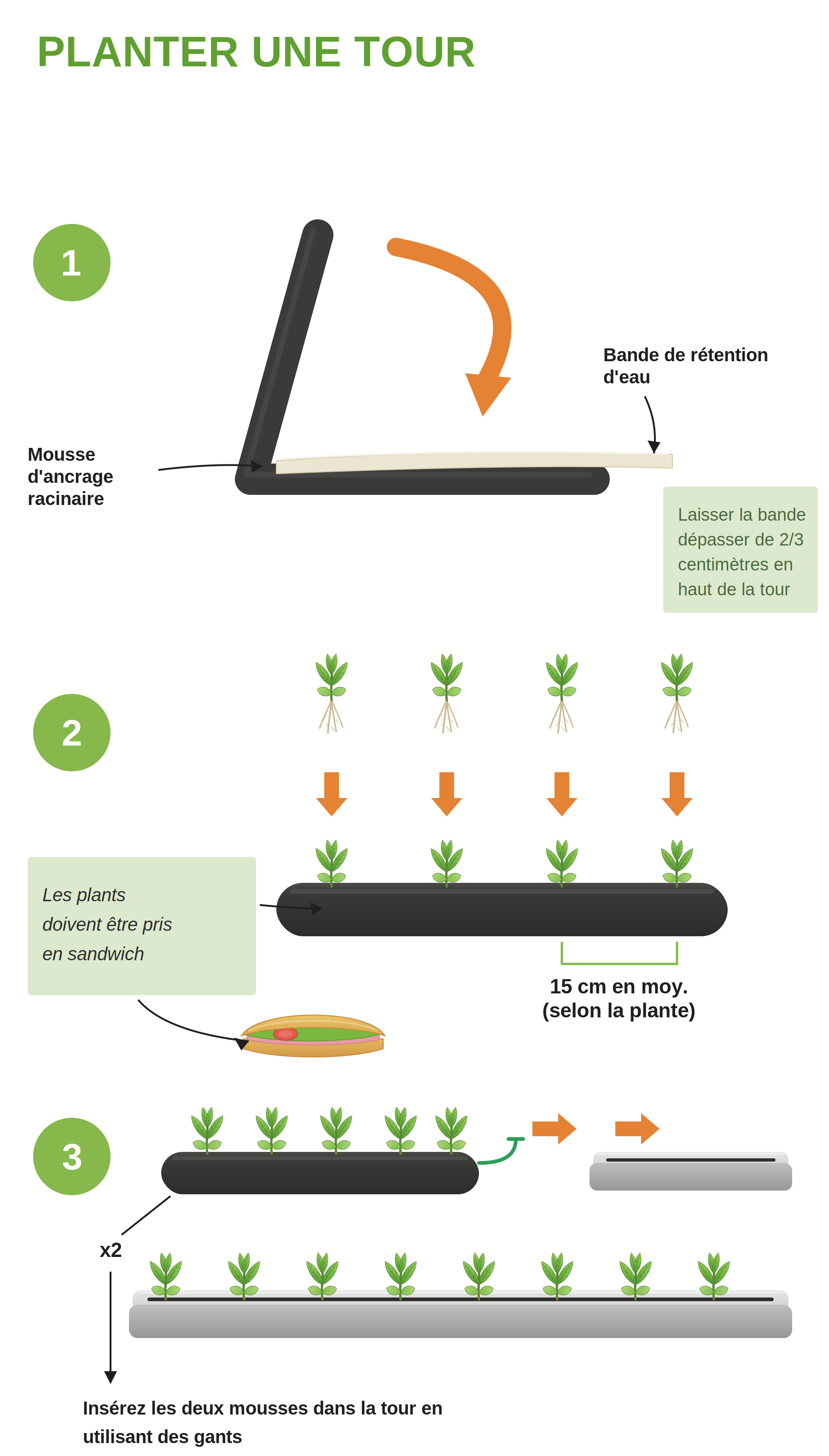
2. How to correctly position the matrices in the growing towers?

Steps to follow :
-
Prepare the work surface
Place the growing tower horizontally on the ergonomic growing table in your greenhouse, slot facing you. Take out the two root-anchoring foams, the two grey felt strips and your plants.
-
Moisten the felt strips.
Immerse each felt strip in clean water until fully saturated, then let it drain without wringing it out. It must be supple and soaked with water: this is what starts the capillary action and distributes the water over the full height of the tower.
-
Place the felt strip in the centre of the tower (sandwich mode)
Open the foam flat, like a book. Place the felt strip in the fold, well centred, along the full length.
-
Install the plants in a sandwich
Align the plants on the felt strip, roots facing inward and foliage facing outward, spacing them about 15cm apart depending on the species. Then close the foam over the top: the roots are sandwiched between the felt strip and the foam, without being crushed or bent.
-
Insert the first foam into the tower
Keeping it flat, present the closed foam at the top of the tower, U opening facing downwards and slide it gently down the tower using the pull hook.
-
Stack the second foam into the tower
Repeat the operation with the second foam, placed edge to edge with the first, also with the U facing upwards. Check that there is no gap between the two, and that the felt strips touch at the join. Put the tower back upright and place it back among the others.
Do not do this
- Put a foam in upside down. The U must never be turned over: the two foams are placed one on top of the other, opening upwards, otherwise the water will no longer circulate
- Leave a gap between the two foams. The join must be edge to edge, with the felt strips in contact: a gap creates a dry area in the middle of the tower.
- Force the insertion. A foam pushed fully in compresses, twists and crushes the roots. It must slide down under its own weight, guided by hand.
- Work with bare hands, or crowd the plants. Gloves are mandatory and one plant every 15 cm approximately: if they are too crowded, they become leggy and compete with each other.
3. Number of plants per tower
Summer vegetables: 3 plants per tower
- Solanaceae: aubergine, pepper, chilli pepper, tomato
- Cucurbits: cucumber, gherkin, courgette, melon, watermelon
- Others: artichoke
1 in the upper matrix and 2 in the lower matrix
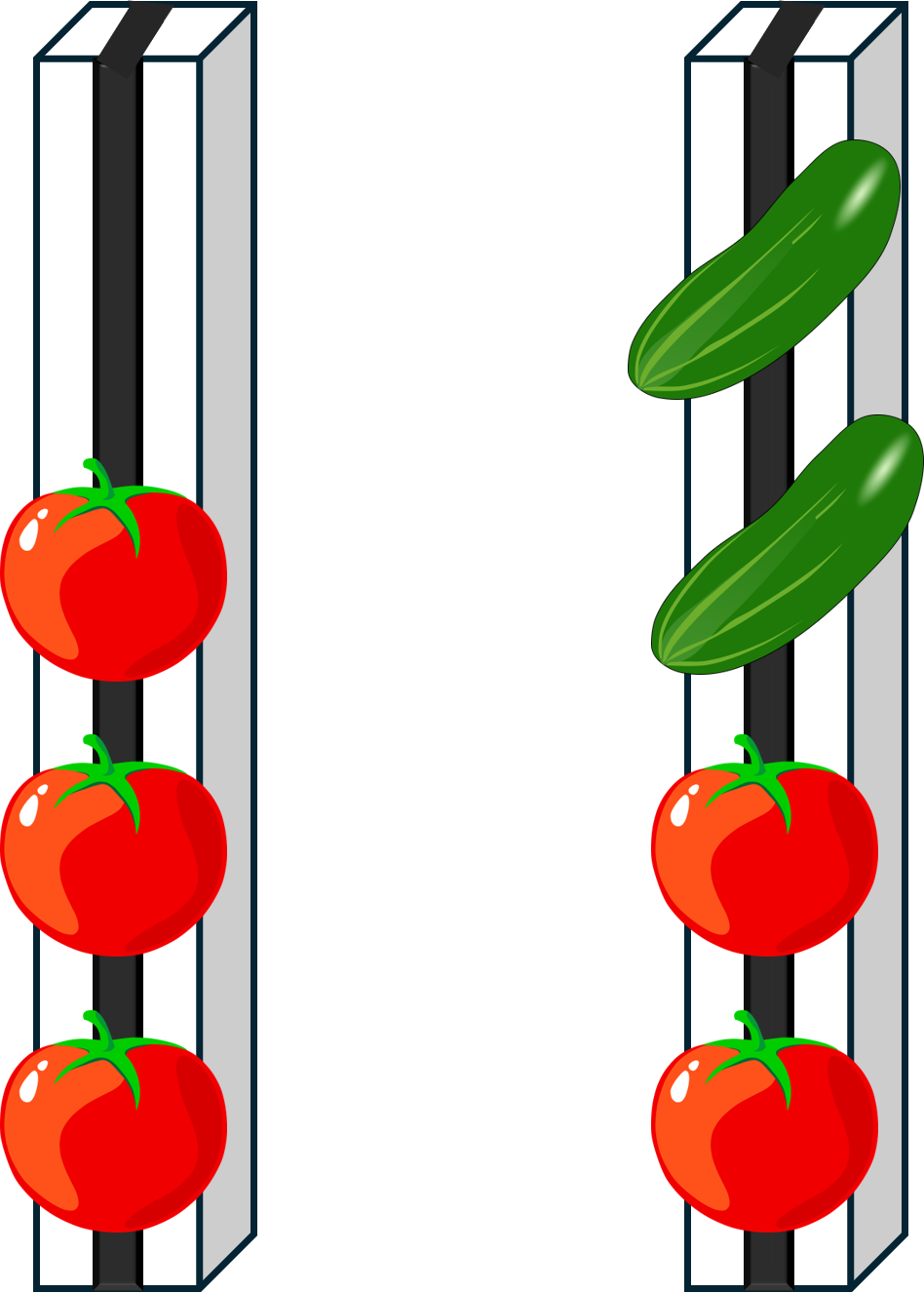
Leafy vegetables: 6 plants per tower
- Cabbages: pointed, curly, broccoli, Chinese, kale, cauliflower
- Swiss chard, celery
Lettuces, young shoots and others: 8 plants per tower
- Lettuces: batavia, oak leaf, salanova, head lettuce, romaine, etc.
- Chicories
- Young shoots: lamb's lettuce, mesclun, rocket, cress, sorrel, purslane
- Others: kohlrabi, fennel, spring onions, spinach, broad bean, bean,
- Herbs: basil, dill, parsley, coriander, etc. .
Small plants such as lamb's lettuce or onions can be planted up to 20 over the full height of the tower.
No root vegetables in towersIt is not possible to grow certain vegetables in towers: potato, sweet potato, Jerusalem artichoke, carrot, turnip.
Growing radishes in towers is possible.
4. Positioning the towers
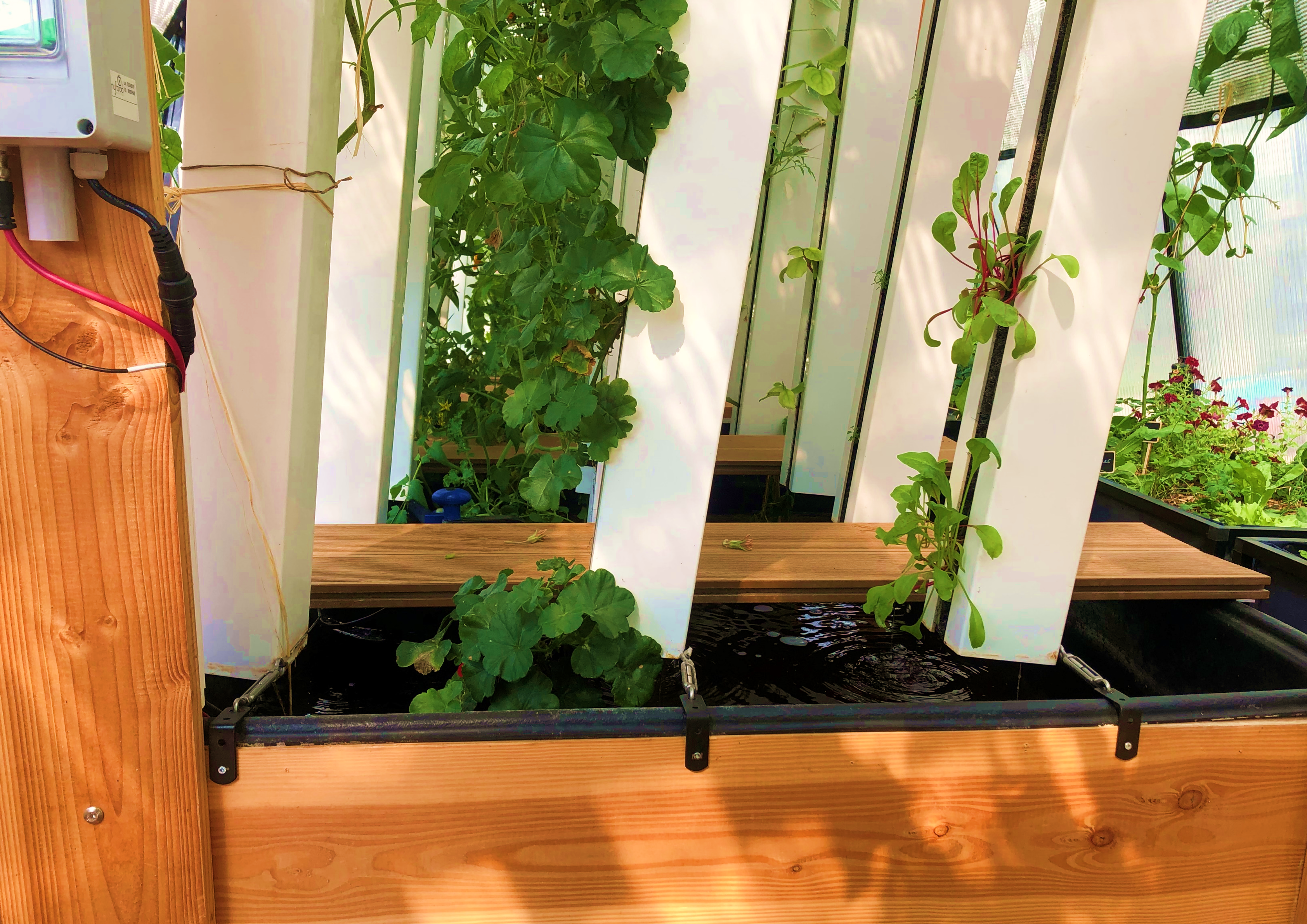
For optimal irrigation of plants in cultivation, make sure that each tower is slightly inclined. The base of the tower is moved slightly forward while the top is positioned further back.
5. Plants not to put in towers
The plants not to put in towers are:
- Peas
- Squashes: these plants require a dry spell to form fruit
- Courgettes: these plants have a hollow stem. The weight will be difficult for the stem to support
- Certain tomato plants, especially those that produce large fruits,
- Purple kohlrabi is temperamental (green kohlrabi works in towers)
- Large cabbages (cauliflower, Brussels sprouts, Savoy,)
- Herbs such as thyme, tarragon, mint etc.. It is difficult to recover the matrices afterwards
- What about strawberries: not all varieties work. The continuous presence of water in the towers can cause root browning.
Updated 8 days ago