
Winter adjustments
Before the first frosts and to grow all winter long.
The winter period is characterized by a lack of light, cold temperatures and high air humidity. Greenhouse crop management must be adapted according to these climatic factors, which are a priori unfavourable for production.
The greenhouse and its equipment make it possible to continue production during this period.
1. Remove the vent struts
During winter, the vents are taken out of service to prevent heat accumulated in the greenhouse from escaping.
Take care of the struts: indoor dry storage recommendedAfter removing the gas struts, we recommend storing them indoors in a dry place. Do not leave them in the greenhouse, as they may be damaged by the cold.
2. Check irrigation
In cold weather, plants evapotranspire less than in summer. In other words, their water needs are reduced and must be adjusted for winter.
AEROSPRING : see our recommendations on our dedicated wiki page. Irrigation must be adjusted to keep the substrates moist in each growing cup of the aerospring.
VERTICAL GROWING TOWERS : keep the pump at maximum flow on the measurement box.
PERMACULTURE BEDS : see our recommendations on our dedicated wiki page to adjust mound watering during winter.
3. Manage air humidity
Plant activity (photosynthesis and respiration) generates water evaporation into the air, even in winter.
In principle, the colder the air, the less water it can hold as vapour. As a result, water will tend to accumulate in the greenhouse mainly as condensation droplets on the structure walls. It is also possible to find droplets on the foliage of plants being grown.
Start ventilation if T > 0°C
The fan increases oxygen renewal in the greenhouse all year round. In winter, it helps renew indoor air to reduce humidity.
Do not start the fan if temperatures are below zero, to avoid cooling the ambient air.
Ventilation must be started manually on the power box.
Air humidity must be between 40% and 80%.
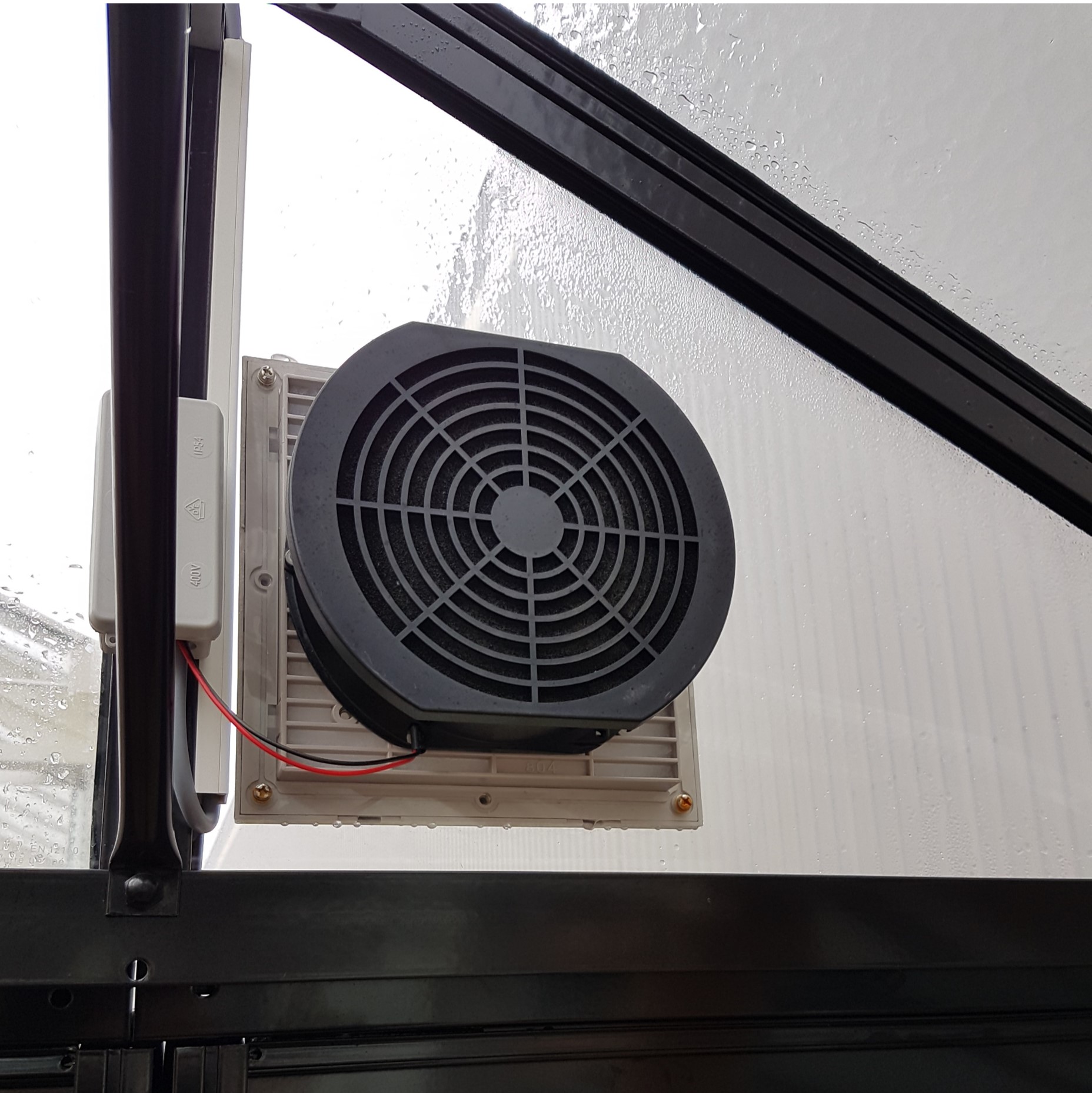
Photo de l'extracteur d'air
More information about the technical specifications of the air extractor is available on our dedicated wiki page.
4. Start the infrared heater, water heating and reduce heat losses
Temperature is an important parameter to ensure the growth of your plants during winter. A minimum of 7-8°C during the day allows plants to activate their metabolism and ensure optimal growth during winter.
Program the infrared heater and connect the heating elementsFor optimal plant productivity, follow our programming recommendations
*[for the stove on our dedicated wiki page] (https://wiki.myfood.eu/docs/poêle-à-granule#1-température-de-programmation).
For fish welfare and proper pump operation, follow our recommendations for setting the heating elements on our dedicated page.
It is recommended to properly close the sliding doors on each side of the greenhouse to limit heat loss. Make sure the door seals touch to seal any leaks.
In addition, if your stove is running and the LED lighting is programmed, it is recommended to keep the shade cloth deployed to reduce the total volume of air to be heated.
On the other hand, if you do not have these modules, do not deploy the thermal screen so you can benefit from maximum light in the greenhouse.
Insulation moduleWe recommend installing insulating panels on the North side of your greenhouse to optimize energy performance inside.
Find more information to install the panels on our dedicated page.
5. Program lighting for plants
In autumn, it is time to program the horticultural lighting for the permaculture beds and vertical growing until March. Its purpose is to make up for the gradual decrease in light levels in order to guarantee the growth of your crops.
Plants need at least 10h of sunlight every day to carry out photosynthesis and grow. LED photosynthetic lighting can meet up to 90% of plants' daily needs.
Find details about LED lighting on our dedicated wiki page.
6. Choose which plant species to grow
Our selection of plant material is suited to winter conditions. The species offered in the seedling kits and the sowing calendar are cold-resistant and tolerate low light.
In winter, we mainly choose "leafy" vegetables. Here are species suited to the season in the greenhouse:
| Category | Plant species |
|---|---|
| Cabbages : the star vegetable of winter | Kale, head cabbage, palm cabbage, white cabbage, kohlrabi Broccoli, cauliflower, romanesco |
| Lettuces Chicories | Romaine, Batavia, oak leaf, Salanova Chiogga, escarole |
| Young shoots | Blood sorrel, mesclun, rocket, lamb's lettuce, purslane, cress |
| Small bulbs | White and red onions |
| Other leafy vegetables | Spinach, chard, celery, artichoke, fennel |
| Herbs and flowers | Lovage, chives, salad burnet, coriander, parsley, borage, pansies |
7. Adjust fertilization
At the change of season, summer plants are removed and replaced with winter vegetables. These are mainly leafy vegetables: cabbages, spinach, onions... Their nutrient needs are lower than those of summer species. It is important to adjust fertilization accordingly, whether you are using aquaponics or bioponics.
Change in fertilization frequency
- If you are using aquaponics: see our production-phase fertilization recommendations on our dedicated page to adapt the quantity and frequency of supplements to your greenhouse model.
- If you are using bioponics: see our production-phase fertilization recommendations on our dedicated page to adapt the quantity and frequency of organic fertilizer according to your greenhouse model.
8. Feed fish in winter
As air and water temperatures decrease, fish activity slows down and they tend to feed less. Their feeding needs are low and they produce less waste than in summer.
To reduce the build-up of uneaten feed on the water surface, it is necessary to lower the amount of pellets distributed.
Reduce the amount of feed or the number of feedingsSee our recommendations in the feeder programming manual.
Avoid excess feed in the waterExcess feed given to fish causes the filter and screen to clog quickly. Also, decomposing feed causes water pollution that is harmful to fish.
The water becomes cloudy when the amount of feed dispensed is too high.