
cultiver-en-aquaponie-1
Aquaponics is a soilless growing method based on the use of fish waste as organic fertilizer for plant growth.
The ZipGrow vertical tower growing system is suitable for two growing methods: bioponics and aquaponics. In both cases, it is a natural growing process. Micro-organisms introduced into the water work to provide the roots with the minerals needed for plant growth.
Aquaponics is the growing method that uses fish to feed plants. Fish waste, rich in nitrogen, provides part of the plants' nutrition. The rest is supplied as soluble mineral salts: magnesium, potassium, iron, calcium and micronutrients.
So, to obtain healthy plants, you simply need to feed your fish and regularly add the aquaponics supplements to the water. The plants will then purify the water that returns to the fish tanks.
Aquaponics requires regular monitoring of the water parameters (hardness, acidity and nitrogen levels), and precautions must be taken to guarantee the welfare of your fish and the growth of your fruit and vegetables.
This choice is not irreversible. You can switch to bioponics whenever you want by following these recommendations .
1. Start cycling – MANDATORY
Growing your plants in aquaponics absolutely requires starting the cycling process to establish bacteria that are beneficial to the nitrogen cycle in the water.
Find all the information about cycling here .
As soon as cycling has started (1), you can start growing your plants to help complete the cycling process before introducing your fish. Remember to add the supplements as soon as the towers are planted.
(1) On your test strip, you can see a pink colour on the NO3- and NO2- pads.
2. Choose your fish
IMPORTANTFish can only be introduced into the fish tanks at the end of the cycling process, i.e. at least 4 weeks after the greenhouse is installed.
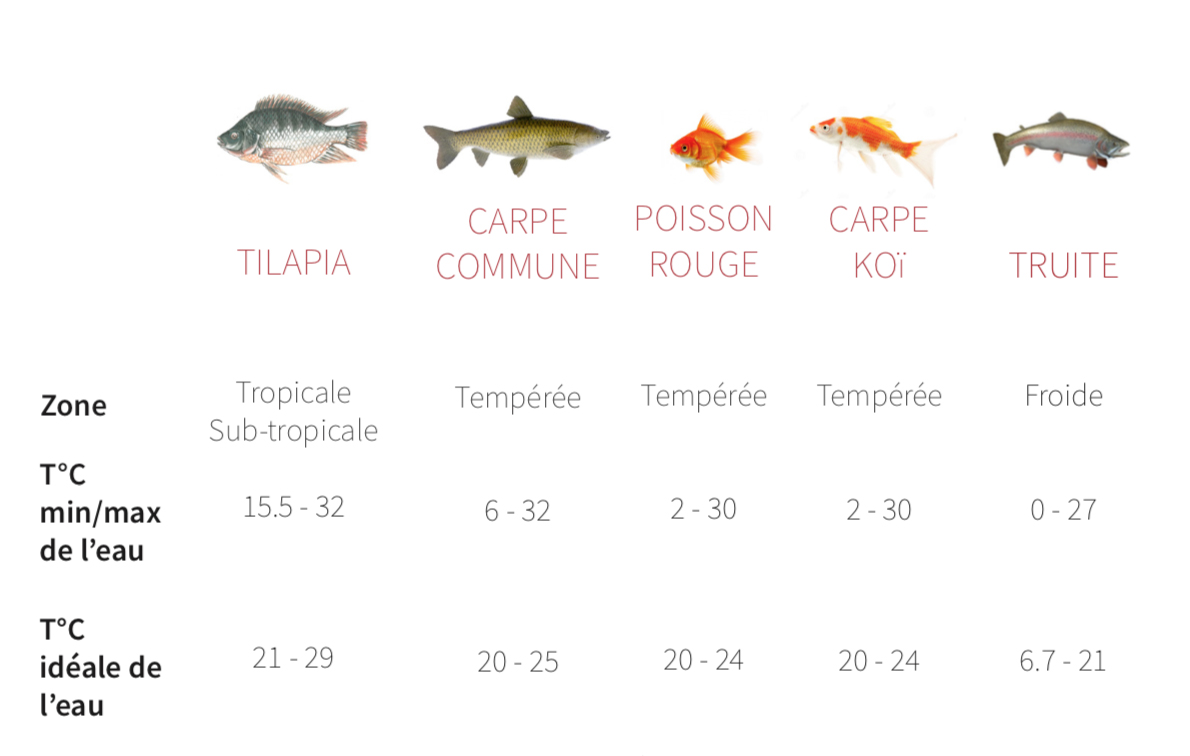
You can introduce fish progressively as your production system develops. See our recommendations for the number of individuals to install at start-up.
For our pioneers in Europe, we recommend introducing goldfish for beginners. They are resistant to temperature and pH changes and provide a satisfactory amount of waste for plant needs.
With a little experience and success, you can then choose edible fish: carp for all seasons, trout for winter, or tilapia in summer.
TipStart with goldfish, then, once you are comfortable with your system, switch to edible fish.
Important principle: avoid mixing species in the same tank.
ImportantIntroducing river or pond fish is strongly discouraged: diseases can spread, contaminate your fish tanks and consequently have an impact on the welfare of your fish and on your health through the consumption of your fruit and vegetables.
3. Add aquaponics supplements
Plants need minerals and micronutrients to grow and produce fruit and vegetables.
The water environment is devoid of these elements, whereas they are naturally present in soil. Therefore, growing in aquaponics requires the addition of salts as a supplement to your fish waste, which acts as fertilizer for plant growth.
The roles of the different aquaponics supplements
- Nitrogen. Plant nitrogen nutrition is initially provided by ammonium sulfate during the cycling period. During the production phase, fish waste takes over to build up the nitrogen stock. Nitrogen is a major element for plant structure and growth.
- Potassium. It is involved in plant cell activity and contributes to the formation and transport of sugars. It therefore guarantees the taste quality of your fruit and vegetables.
- Magnesium. It is involved in chlorophyll formation and photosynthesis. As a result, the leafy parts of your plants are vigorous enough to support fruit and vegetable production.
- Calcium. It plays a role in the formation of cell walls and membranes, but is also involved in regulating enzyme activity. It therefore ensures stem rigidity and the good health of the edible parts of the plant.
- Iron. It is involved in regulating metabolic exchanges in the plant.
- Micronutrients. They complete and reinforce the action of the supplements listed above for vigorous, productive plants.
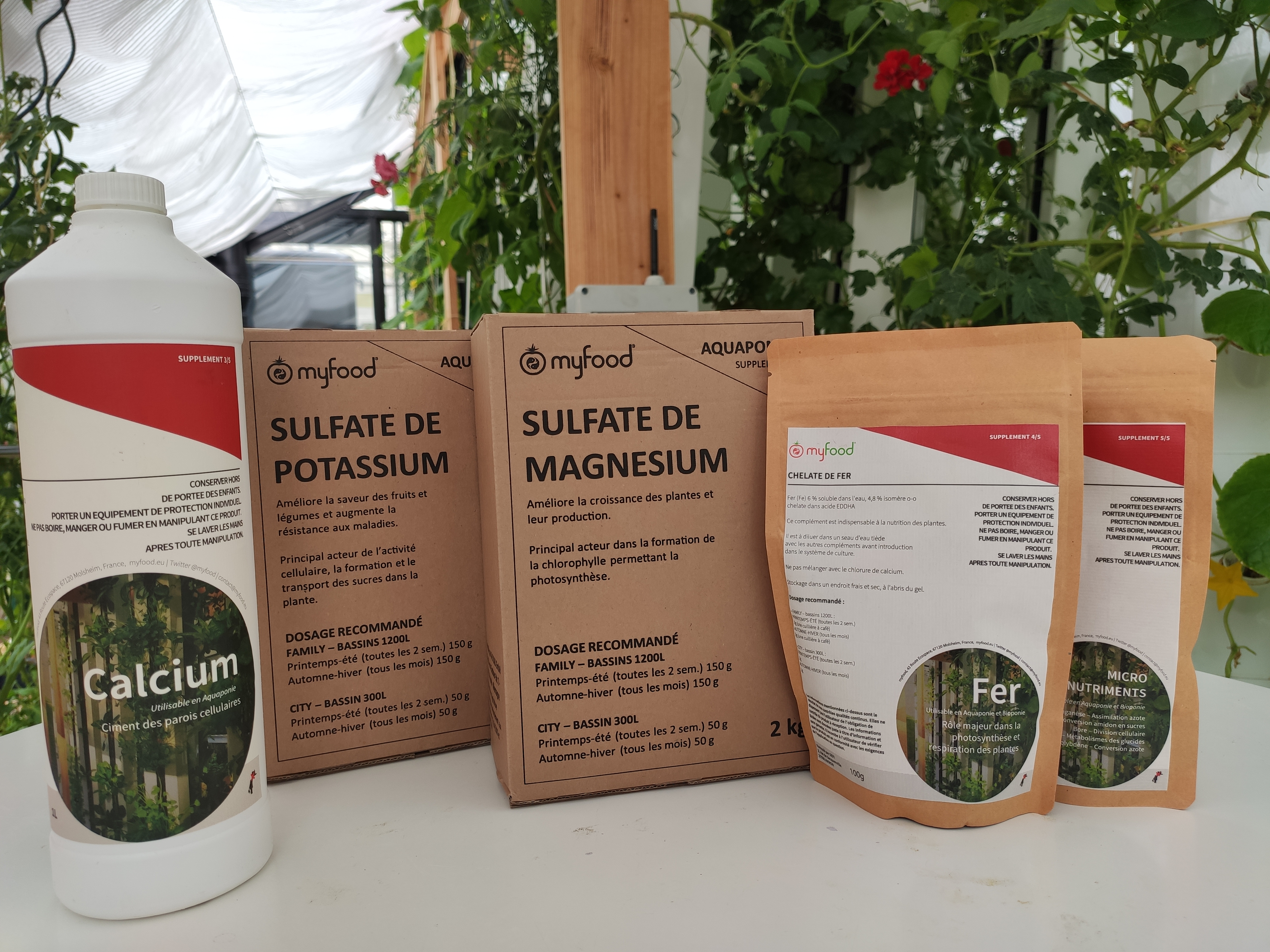
Photo of the aquaponics supplements to add to the water for plant growth.
4. Our recommendations
To avoid deficiencies in your bioponic system, we recommend regularly adding aquaponics supplements to the water.
By following the recommendations in the tables below, you ensure optimal growing conditions for your fruit and vegetables throughout the year.
Impact of salts and minerals in your system> Given the total dilution in the water, the quantities of supplements do not affect fish welfare.
STEP 1: start-up phase (cycling)
to add nitrifying bacteria and ammonium sulfate to your system.
| Model CITY | Model FAMILY - 1 tank | Model FAMILY - 2 tanks | Model FAMILY - 3 tanks | |
|---|---|---|---|---|
| DAY 1 - Quantity of ammonium sulfate | 8 g | 20 g | 50 g | 80 g |
| DAY 1 - Quantity of bacteria | 1 scoop | 2 scoops | 4 scoops | 6 scoops |
| DAY 1 - Quantity of iron chelate | 1 teaspoon | 2 teaspoons | 3 teaspoons | 5 teaspoons |
| DAY 14 - Quantity of ammonium sulfate | 8 g = 2 teaspoons | 20 g = 2 tablespoons | 50 g = 4 tablespoons | 80 g = 6 tablespoons |
STEP 2: production phase (pH 6,5 to 6,8)
As soon as plants are growing, aquaponics supplements must be introduced regularly into your system to support plant growth.
Find below the quantities, frequencies and methods for additions according to the season.
Model CITY
| Model CITY | SPRING-SUMMER From March to October Every 2 weeks | AUTUMN-WINTER From October to March Every 4 weeks |
|---|---|---|
| CALCIUM CHLORIDE | 50 mL | 50 mL |
| POTASSIUM SULFATE | 50 g | 50 g |
| MAGNESIUM SULFATE | 50 g | 50 g |
| IRON CHELATE | 1 g (1/4 teaspoon) | 1 g (1/4 teaspoon) |
| MICRONUTRIENTS | 1 g (1/4 teaspoon) | 1 g (1/4 teaspoon) |
Model FAMILY - 1 tank
| Model FAMILY - 1 tank | SPRING-SUMMER From March to October Every 2 weeks | AUTUMN-WINTER From October to March Every 4 weeks |
|---|---|---|
| CALCIUM CHLORIDE | 50 mL | 50 mL |
| POTASSIUM SULFATE | 75 g | 75 g |
| MAGNESIUM SULFATE | 75 g | 75 g |
| IRON CHELATE | 2 g (1/2 teaspoon) | 2 g (1/2 teaspoon) |
| MICRONUTRIENTS | 2 g (1/2 teaspoon) | 2 g (1/2 teaspoon) |
Model FAMILY - 2 tanks
| Model FAMILY - 2 tanks | SPRING-SUMMER From March to October Every 2 weeks | AUTUMN-WINTER From October to March Every 4 weeks |
|---|---|---|
| CALCIUM CHLORIDE | 100 mL | 100 mL |
| POTASSIUM SULFATE | 150 g | 150 g |
| MAGNESIUM SULFATE | 150 g | 150 g |
| IRON CHELATE | 3 g (1 level teaspoon) | 3 g (1 level teaspoon) |
| MICRONUTRIENTS | 3 g (1 level teaspoon) | 3 g (1 level teaspoon) |
Model FAMILY - 3 tanks
| Model FAMILY - 3 tanks | SPRING-SUMMER From March to October Every 2 weeks | AUTUMN-WINTER From October to March Every 4 weeks |
|---|---|---|
| CALCIUM CHLORIDE | 150 mL | 150 mL |
| POTASSIUM SULFATE | 225 g | 225 g |
| MAGNESIUM SULFATE | 225 g | 225 g |
| IRON CHELATE | 5 g (1 heaped teaspoon) | 5 g (1 heaped teaspoon) |
| MICRONUTRIENTS | 5 g (1 heaped teaspoon) | 5 g (1 heaped teaspoon) |
Method for adding supplements
- Dissolve the salts (magnesium sulfate, potassium sulfate, iron and micronutrients) in a container with 2 L of lukewarm water
- Stir well until completely dissolved
- Add the mixture to the water, distributing it among the tanks.
- Add the calcium separately directly to the water, 10 minutes apart from the salts (before or after).
Do not mix calcium chloride with sulfates, as this may form precipitates.Be sure to add it separately directly into the water.
Potassium sulfateSince August 2024, potassium sulfate has been available in granule form, which considerably increases its dissolution time in water.
For optimal use, continue to mix it with magnesium sulfate, iron chelate and micronutrients. Once thoroughly mixed, the potassium sulfate granules will still remain in granule form. Pour everything into the tank(s).
This mixture will have no impact on fish health.
Boost your plant growth
Are you seeing deficiencies in your plants? Do your plants lack vigour? You can add root activators to your system according to the recommendations below.
| Quantity of activators | Addition frequency | |
|---|---|---|
| Model CITY | 2 tablets/tank | Spring-summer: 1 application in spring; Autumn-winter: 1 application every 3 months |
| Model FAMILY - 1 tank | 3 tablets/tank | Spring-summer: 1 application in spring; Autumn-winter: 1 application every 3 months |
| Model FAMILY - 2 tanks | 3 tablets/tank | Spring-summer: 1 application in spring; Autumn-winter: 1 application every 3 months |
| Model FAMILY - 3 tanks | 3 tablets/tank (max 6 tablets) | Spring-summer: 1 application in spring; Autumn-winter: 1 application every 3 months |
The root activator mix is compatible with the aquaponics growing method.
Method of addition - root activatorsUnlike aquaponics supplements, the root activator must not be introduced directly into the water in the tanks. It must be diluted and then added at the black tube.
- Dissolve the root activator tablets in 200 mL of water using the measuring jug
- In the greenhouse, stop the pump, open the black tube at the filter outlet
- Pour the mixture directly into the black tube, close it and restart the pump
Thanks to this method, the micro-organisms will settle directly in the matrix of your growing towers, as close as possible to the roots, and improve plant growth.
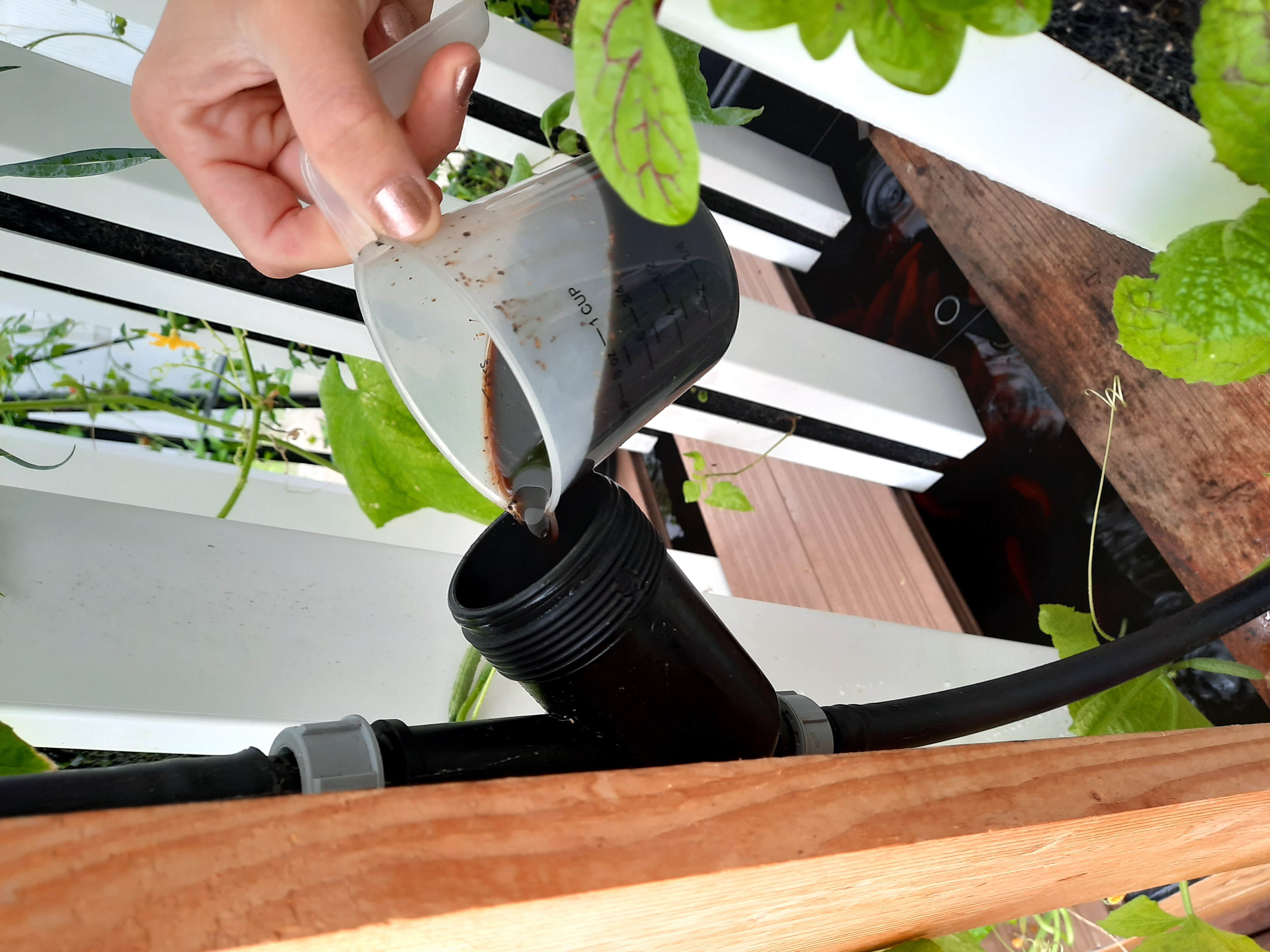
Adding the root activator at the screen nozzle.
If you have any other questions about aquaponics growing, contact us directly at[email protected] .