
Water management
Compensate for water losses in the aquaponic or bioponic system.
The summer season leads to rising temperature variations. These have direct consequences on the operation of growing systems.
Here are the main causes of the drop in the water level of the fish tanks:
- 75% Water uptake by plants: when the plants being grown feed, they consume water by taking up nutrients.
- 20% Evaporation: the increase in outdoor temperatures can cause a small part of the water volume in the fish tanks to evaporate.
- 5 % External runoff: plants can drip onto one another vertically and then drip outside the fish tanks.
1. Actions to reduce water loss
It is recommended to install the Performance module to boost crop production performance in your greenhouse.
Benefits of the Performance moduleThe Performance module consists of:
- Shade boards for the fish tanks
The boards help limit direct evaporation of water from the fish tanks.- A tower tilting system
Tilting the vertical growing towers prevents plants from dripping onto one another and then outside the fish tanks. Thanks to this modification, the water falls back into the fish tank(s) after irrigating the crops.- Irrigation pipes
Extending the irrigation nozzles directs the water into contact with the felt inside the growing tower. Water loss from splashing is reduced as much as possible.
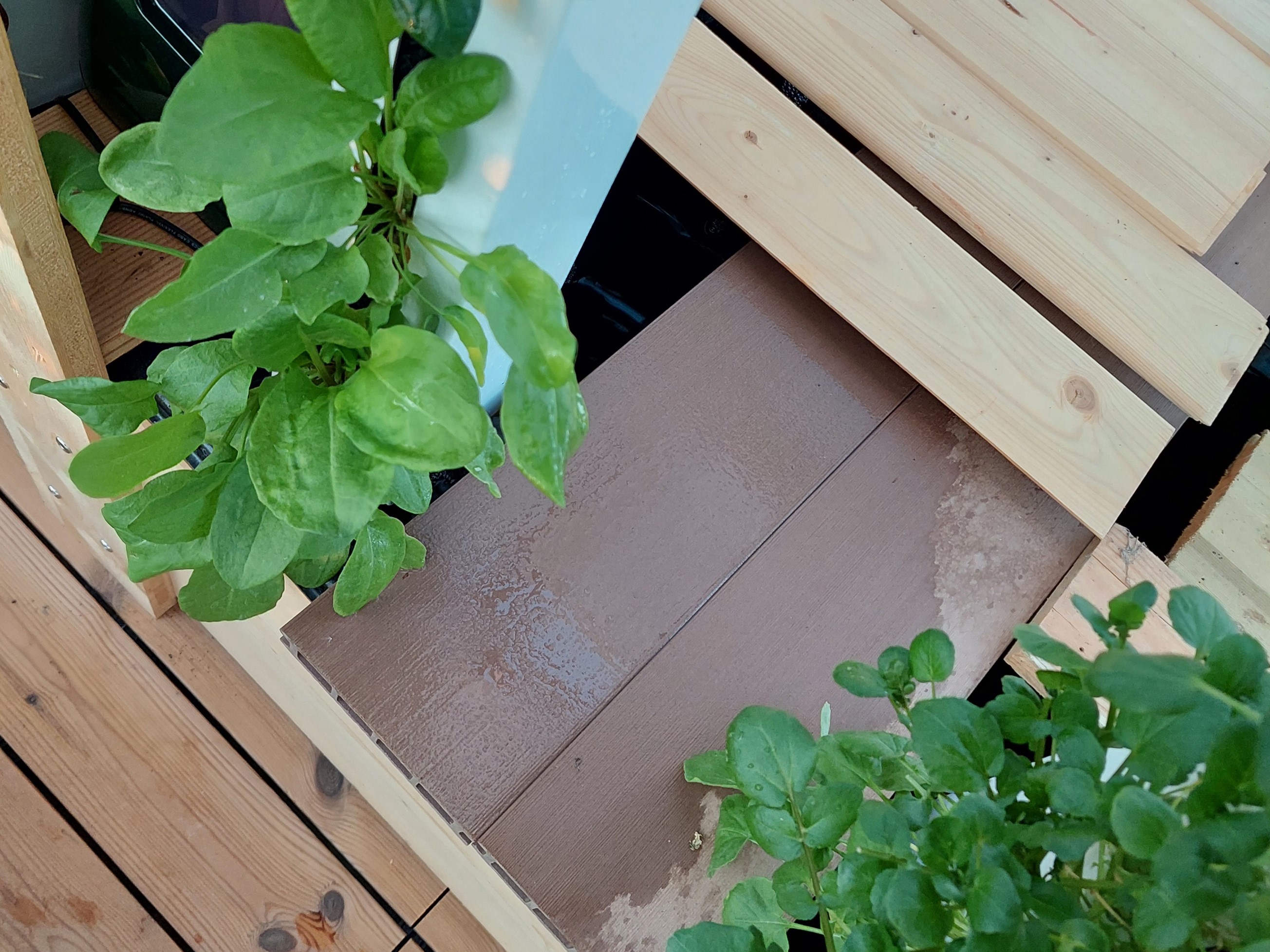
Pertes en eau par goutte à goutte à l'extérieur des bassins
In addition, it is important to follow our recommendations on summer adaptations to prevent overheating in your greenhouse.
2. Keep the water flow rate at maximum
To ensure optimal plant growth all year round, it is recommended to keep irrigation for the vertical growing towers at the maximum level.
Pump power at 10 on the measurement unitCheck every week that all towers are irrigated correctly.
The irrigation nozzles and tubes must be in contact with the felt in the tower for localized irrigation.
In addition, it is important to follow our recommendations on summer adaptations to prevent overheating in your greenhouse.
3. Oxygenate the water in the fish tanks
Dripping from the towers ensures continuous movement of the water in the fish tanks. Nevertheless, it is essential to run the bubbling system continuously.
With heat, oxygenation in the water is reduced. It is important to check that the air diffusers are properly submerged in the water and in each fish tank.
The air pump / aerators must be submerged to ensure optimal water oxygenation.Poor oxygenation can affect the well-being of your fish, but also plant nutrition.
4. Frequency and quantity for topping up water
The tables below indicate the quantities of water to add to the fish tanks depending on the temperatures.
| Outdoor temperatures between 15 and 25°C | CITY model | FAMILY model - 1 fish tank | FAMILY model - 2 fish tanks | FAMILY model - 3 fish tanks |
|---|---|---|---|---|
| Top-up frequency | Once a week | Once a week | Twice a month | Twice a month |
| Quantity of water per addition | 75 L | 50 L | 200 L | 200 L |
If the air temperature is 20°C, on average, for a Family, you will need to add 200 L of water every 2 weeks to maintain the fish tank level.
| Outdoor temperatures above 30°C | CITY model | FAMILY model - 1 fish tank | FAMILY model - 2 fish tanks | FAMILY model - 3 fish tanks |
|---|---|---|---|---|
| Top-up frequency | 2 to 3 times a week | Once a week | Once a week | Once a week |
| Quantity of water per addition | 50 L | 100 L | 200 L | 300 L |
| System autonomy in days | 3 | 5 | 7 | 7 |
For example: if the air temperature is 32°C, on average, for a Family, you will need to add 200 L of water per week to maintain the fish tank level and compensate for water losses.
Type of water to useIt is recommended to alternate topping up the fish tanks with mains water and soft water (rainwater/RO water).
You can check the KH and pH water parameters and determine the appropriate type of water to use. This way, you adjust as accurately as possible without affecting the carbonate balance.
Check that your fish tanks are at the correct level on this wiki page.
5. Case of permaculture beds
When filling the reservoirs, check the top of the growing bed. When you put your fingers into the substrate and it is dry, it is necessary to water from above.
Here is the advice for watering permaculture beds in spring and summer:
| Filling the reservoir (tap water or rainwater) | Watering the plants from above (aquaponics/bioponics sludge or tap water or rainwater) | |
|---|---|---|
| April, May, June and September | Twice a month | Once a week |
| July and August | Once a week | 1 to 2 times a week |
Reusing aquaponics/bioponics sludge for wateringYou can use the wastewater from filter cleaning to water the permaculture beds from above. The plants will be able to benefit from the nutrients present in the water.
However, it is not recommended to fill the water reservoir of the beds with the outgoing sludge.