
gerer-durete
1. Definition
The KH carbonate hardness of water corresponds to the amount of carbonates present in the environment. It therefore constitutes the buffering effect of the water, in other words its ability to stabilize pH. Once balance is reached, pH will be easier to adjust and will remain stable over time.
WarningDo not underestimate the importance of this step, especially if you are using aquaponics. If the hardness is not correct, the pH will be difficult to adjust.
Please note: a KH that is too low can affect the well-being of your fish and lead to deaths within your stock.
2. Measure the KH of the water
Carry out a test strip test to determine the KH value (carbonate hardness of the water linked to dissolved carbonates).
Reliability of test stripsTest strips are useful for measuring water hardness and nitrate and nitrite levels.
The reference for pH measurement is the probe, which provides a precise real-time measurement. Its measurements are visible on the hub.
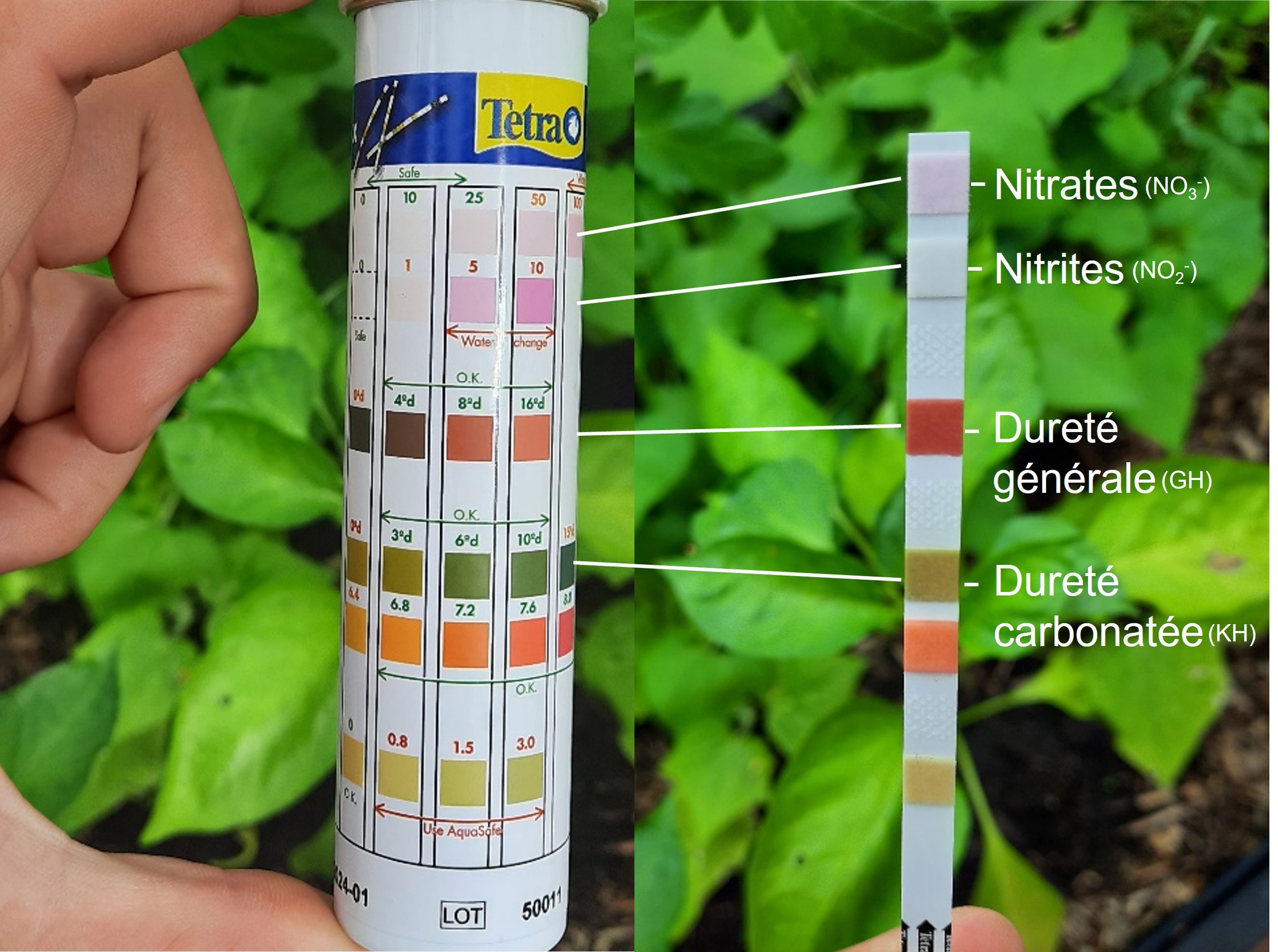
Photo of a test strip showing a KH value equal to 4°d.
3. Adjust the KH value between 4 and 5°d
If KH < 4°d: the buffering capacity of the water is low, which means significant pH variations in the water. Fish tolerate these variations poorly and the bacteria involved in transforming fish waste die. The biological filter stops. Carbonates are essential for pH stabilization.
If KH > 5°d: carbonates in the water act as a buffer, so pH variations are very limited. Above 6, the buffering effect of carbonates is too strong, resulting in a pH that remains too high and is difficult to lower despite adjustment attempts.
4. Increase the KH
Here are the two ways to increase KH; if necessary, they can be applied at the same time:
- Adding tap water (KH>6°d) increases the overall KH in the water of the fish tanks.
- If you do not have hard water, add potassium bicarbonate to the water according to the recommendations below. The powder must first be diluted in a bucket filled with 1L of lukewarm water.
| CITY model | FAMILY model - 1 fish tank | Family model - 2 fish tanks | Family model - 3 fish tanks | |
|---|---|---|---|---|
| POTASSIUM BICARBONATE | 1 teaspoon (max. 3 times) | 1.5 teaspoons (max. 3 times) | 2 teaspoons (max. 6 times) | 3 teaspoons (max. 6 times) |
Potassium bicarbonatePotassium bicarbonate contains carbonates that act by neutralizing the acids present in the water. Visit our shop to order it.
5. Decrease the KH
The only way to decrease KH is as follows:
- Adding soft water (rainwater or reverse osmosis water) reduces the carbonate load in your system. You can replace 1/3 of the volume of your fish tanks with rainwater or reverse osmosis water.
6. Use the reverse osmosis unit
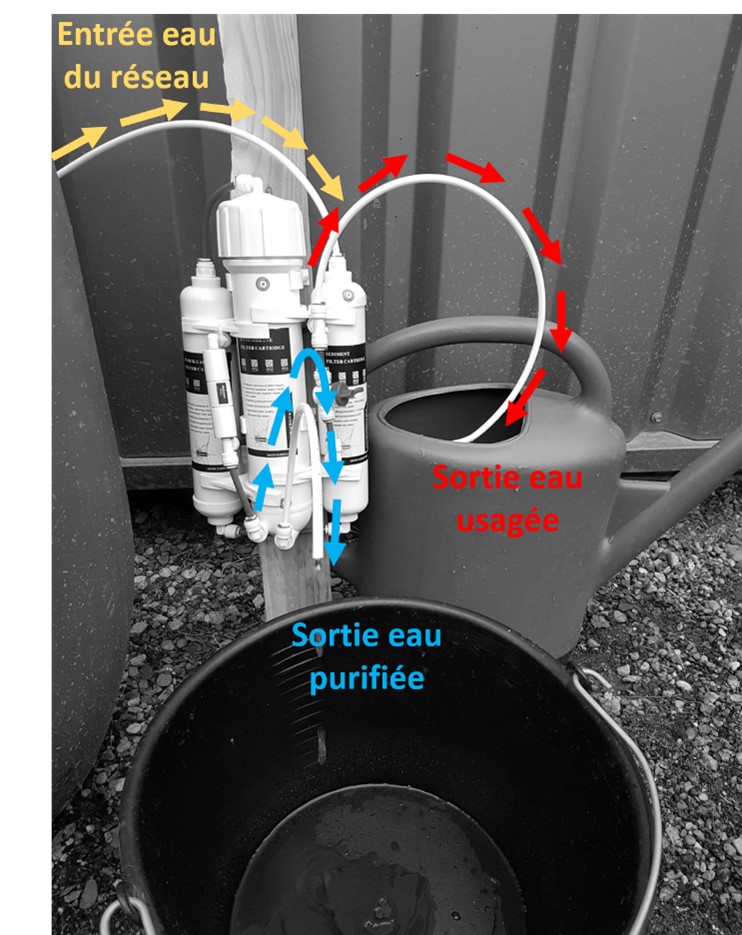
Using the reverse osmosis unit to obtain water free of carbonates
How the reverse osmosis unit works:
- Connect the reverse osmosis unit to your mains water supply
- Place the purified water outlet below your fish tanks
- Use the wastewater to fill the water reservoir of your permaculture beds or to water your garden.
Find more details about the reverse osmosis unit on our dedicated page.
PerformanceA reverse osmosis unit produces 5L of purified water / hour (depending on the hardness of the water entering the system).
If you have other questions about managing carbonate hardness, contact us directly at [email protected].