
Light management
From October to March: additional light thanks to the horticultural lighting module.
The greenhouse is designed to produce fruit and vegetables all year round. Nevertheless, light intensity is an important factor in ensuring satisfactory production in winter. Depending on the orientation of the greenhouse and the desired crop yield level, it is recommended to install horticultural LED lighting.
Adding LED lighting offers many advantages:
- Increased crop productivity
- Compensation for the reduced photoperiod in winter
- Attractive energy efficiency
- Reduced electricity consumption
- Low heat emission from LED bars
1. The importance of the light spectrum
White LED covers the active spectrum for plant photosynthesis. White light contains all the colours visible to the human eye. Below, the McCree curve (= plant sensitivity curve to wavelengths) shows that all colours play a role in photosynthesis and plant response.
Therefore, white light is more effective for metabolic balance and plant growth.
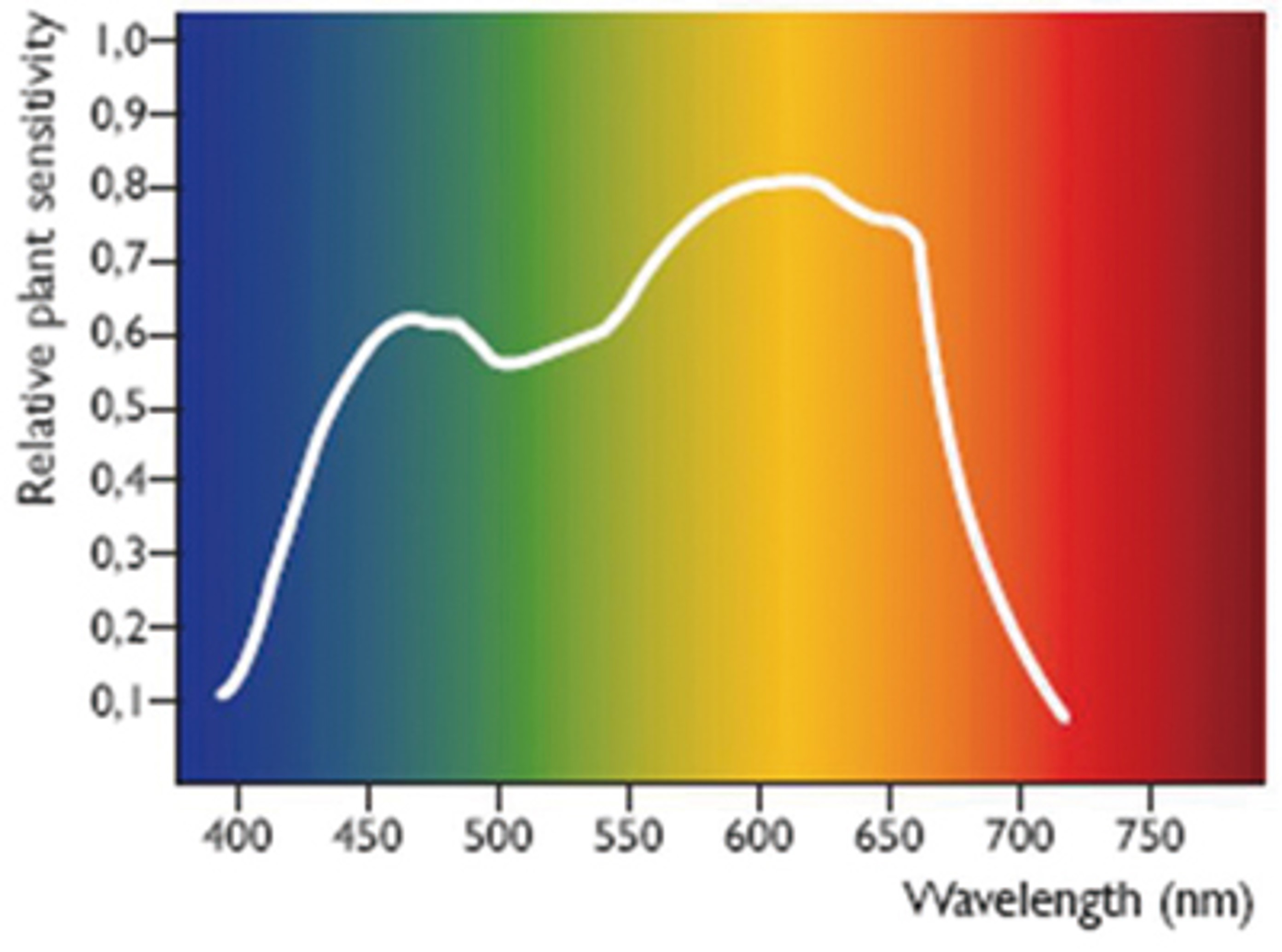
Courbe de McCree : toutes les longueurs d'onde de la lumière blanche ont un rôle dans la photosynthèse des plantes.
2. Increase production performance with supplemental light
In winter and during the transition seasons, adding lighting increases plant activity: they transpire and consume water and nutrients. Controlled irrigation of the towers and the Aerospring makes it possible to meet these additional plant needs.
Optimal plant nutrition improves fruit quality and colour. The sugar content in each plant promotes the formation of quality tissues and the production of healthy, vigorous fruit and vegetables.
Advantage of LED lightingHeat emissions from LED are very low. Plants are in comfortable growing conditions, without a temperature gradient that could disrupt proper physiological functioning between the different parts of the plant (for example: between the top of the plant and the roots).
Plants need a minimum photoperiod of 10h of light per day with sufficient intensity to carry out photosynthesis. In winter, in Europe, the daily length of daylight can drop to 8h with low intensity. Naturally, plants go dormant until spring. To compensate for this drop in light (quantity and intensity), supplemental photosynthetic LED lighting can cover up to 90% of daily needs depending on the weather.
3. Adjust the lighting
The total global radiation is considered to be below the critical threshold for plant needs between October and March. December is the darkest period. Photosynthetic supplementation with LED lighting can account for up to 90% of the amount of light received by the plant over a day.
At the end of winter, the photoperiod and light intensity increase again. Consequently, photosynthetic supplemental lighting will account for less than 10% of the total daily global radiation.
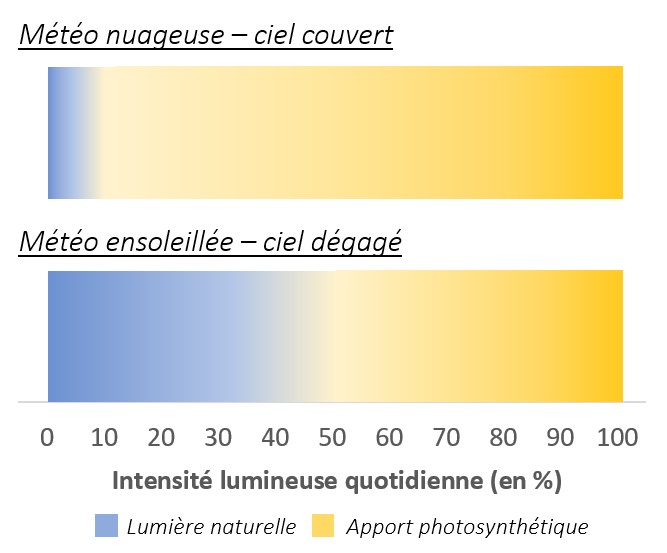
Cas météo nuageuse : 10% des besoins lumineux journaliers sont apportés par la lumière naturelle et les 90% restants sont comblés par l'éclairage LED.
Cas météo ensoleillée : jusqu'à 50% des besoins lumineux journaliers sont apportés par la lumière naturelle et les 50% restants sont comblés par l'éclairage LED.
4. How the horticultural lighting module works
This module includes 2 independent lighting systems for maximum crop productivity. The LED growth bars provide a progressive supply of white light regulated according to brightness and temperature in the greenhouse thanks to sensors. They include all the wavelengths useful for the growth of your fruit and vegetables during winter and the transition seasons.
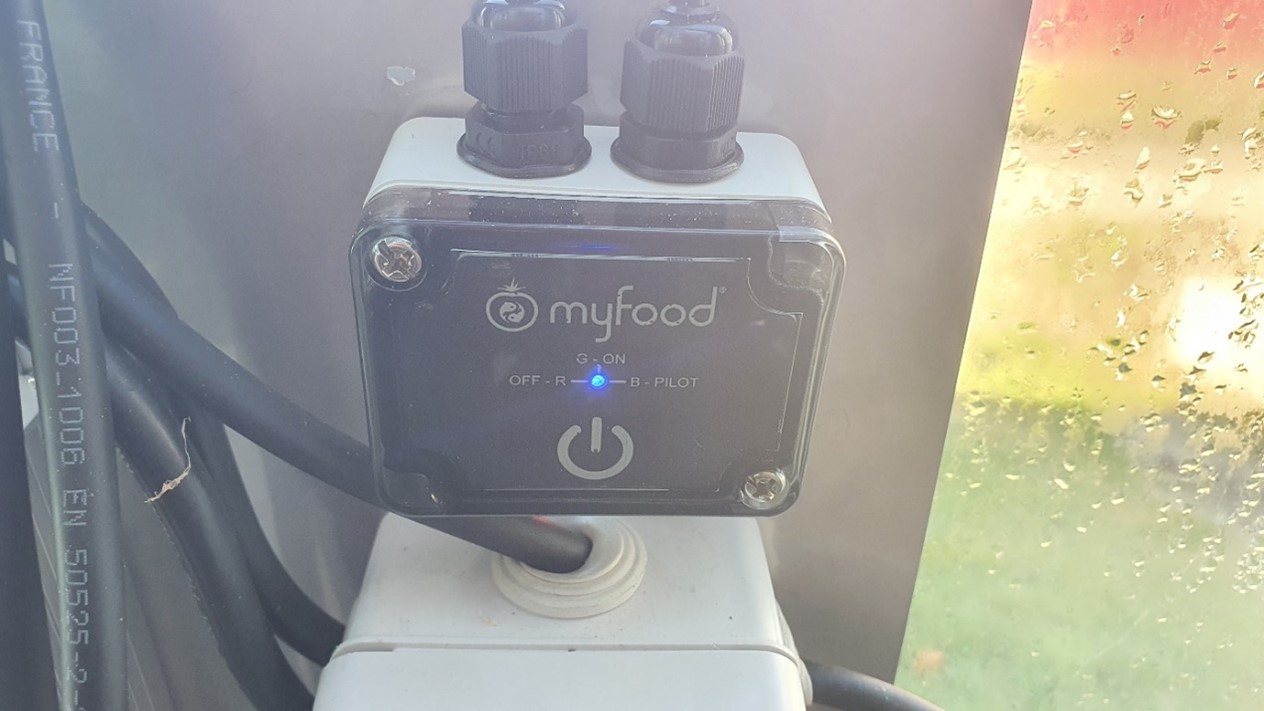
Photo du dispositif de contrôle de l'éclairage horticole.
Table of lighting operating modes:
| ON | Green LED | The lighting is on at maximum. |
| OFF | Red LED | The lighting is off. |
| PILOT | Blue LED | The lighting is managed automatically by the device according to the brightness and temperature in the greenhouse during the day. |
How PILOT mode works
- If the temperature drops below 8°C, the lighting switches off because the plants are then in a dormant state.
- If the temperature is above 8°C, the system manages lighting variation according to the light intensity in the greenhouse.
- PILOT mode detects light intensity for optimal operation corresponding to plant needs depending on the time of day. The lighting will always be off at night.
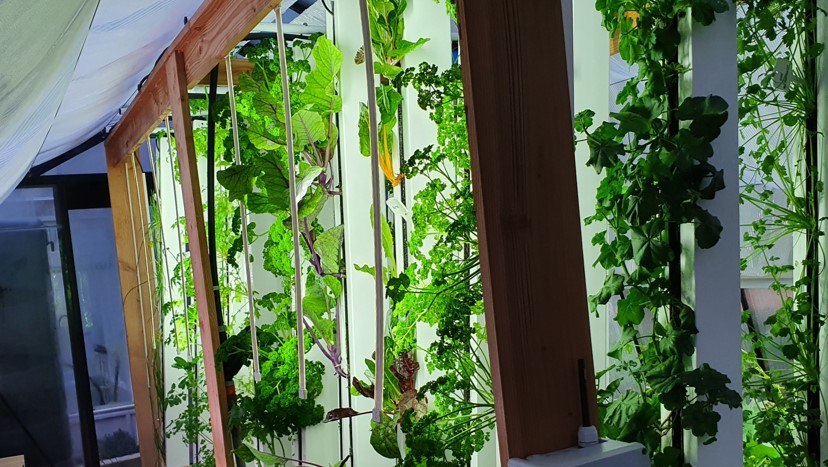
Eclairage LED horticole en aquaponie/bioponie.
The LED are positioned between the tower columns for optimal lighting of all your vegetables.
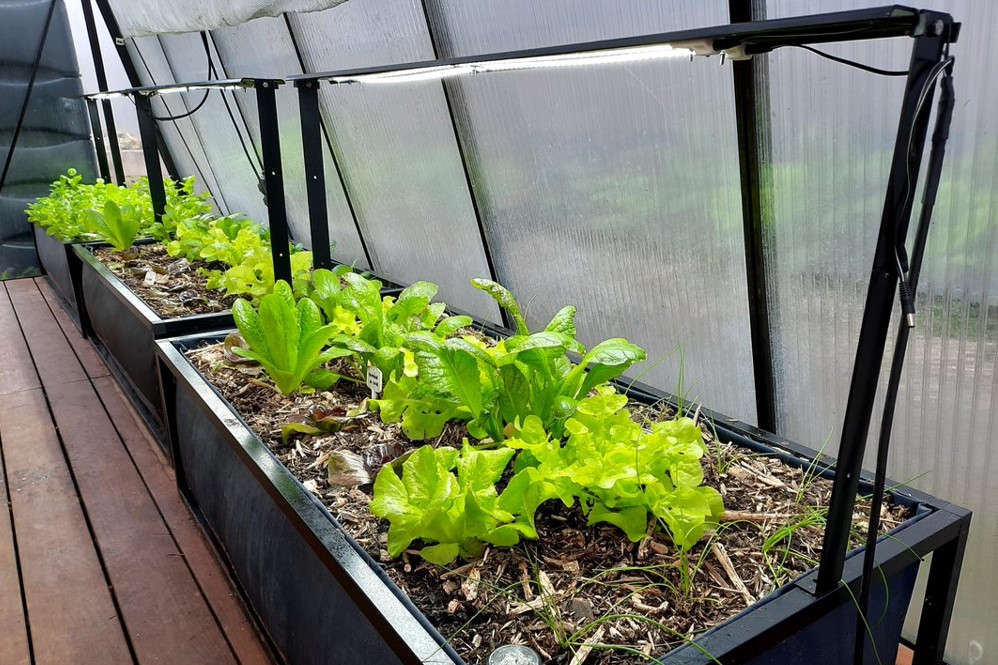
Eclairage LED horticole en permaculture.
The LED support structure is adjustable (10cm, 25cm, 50cm) to adapt to the progressive growth of your plants.