
Main pests
Identify to take effective action.
Your greenhouse hosts a wide biodiversity: plants, pollinators, beneficial insects, insects, fungi... Many organisms are beneficial and useful for the balance of this ecosystem.
However, some organisms can be harmful to your crops if they are not managed in time. Each species has its own harm threshold. Generally, the presence of a few individuals is not a problem; this is even a normal situation. It is when the population becomes denser that there can be an impact on plants and their productivity.
Stay vigilant and observant so you can adapt your action and protect your crops.
Non-exhaustive list of the pests most commonly found in the greenhouse
- Mites
- Whiteflies
- Caterpillars
- Leaf miners
- Aphids
- Thrips
Guide to identifying pests, deficiencies and diseasesAccess this guide to help you diagnose them by clicking this link.
1. MITES (Cucurbits, Beans, Peas)
Mites, also called spider mites, look like small brown-red spiders.
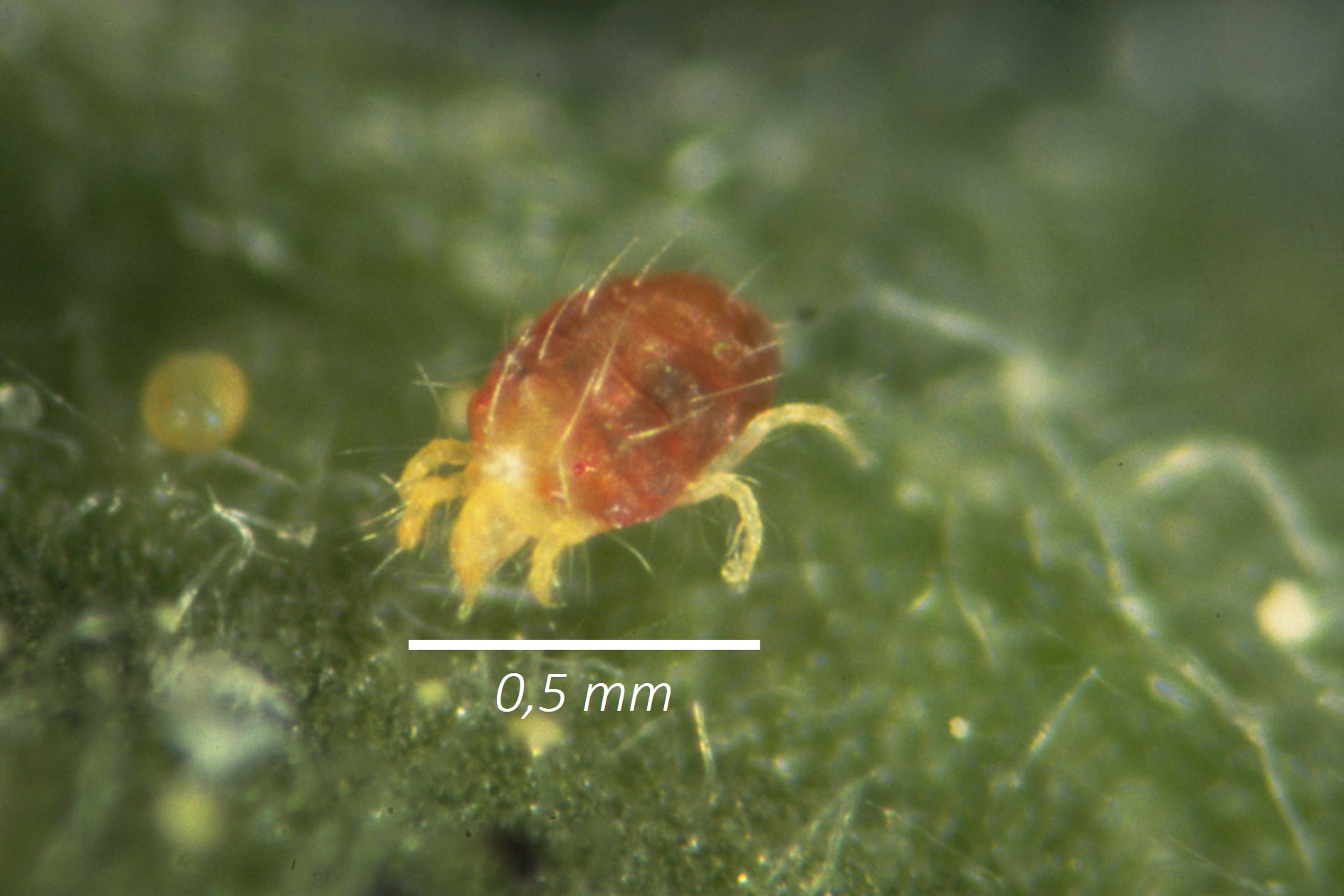
Photo of an adult mite (source: Koppert)
IDENTIFICATION SHEET
Size Invisible to the naked eye.
Location Under the leaves.
Target crops Cucurbits, beans, peas.
Pest stage Larva, nymph and adult.
Climate Hot and dry (temperature > 25°C and humidity < 40%) - June to August.
Spread Fast, from one plant to another by contact.
Colonisation At 25°C, the mite population doubles in less than 3 days.
Harm threshold At least 10 punctures (yellowing) on one leaf or the appearance of webbing on the plant.
Symptoms observed by pioneers
- Partial or total yellowing on the leaf surface
The mites present under the leaves feed on the contents of the plant cells. The emptied cells die and turn yellow. As a result, small yellow spots appear on the leaf surface. - Webbing
As the mite population develops, the nymph and adult stages weave a characteristic web around the plant. The mites live inside it.
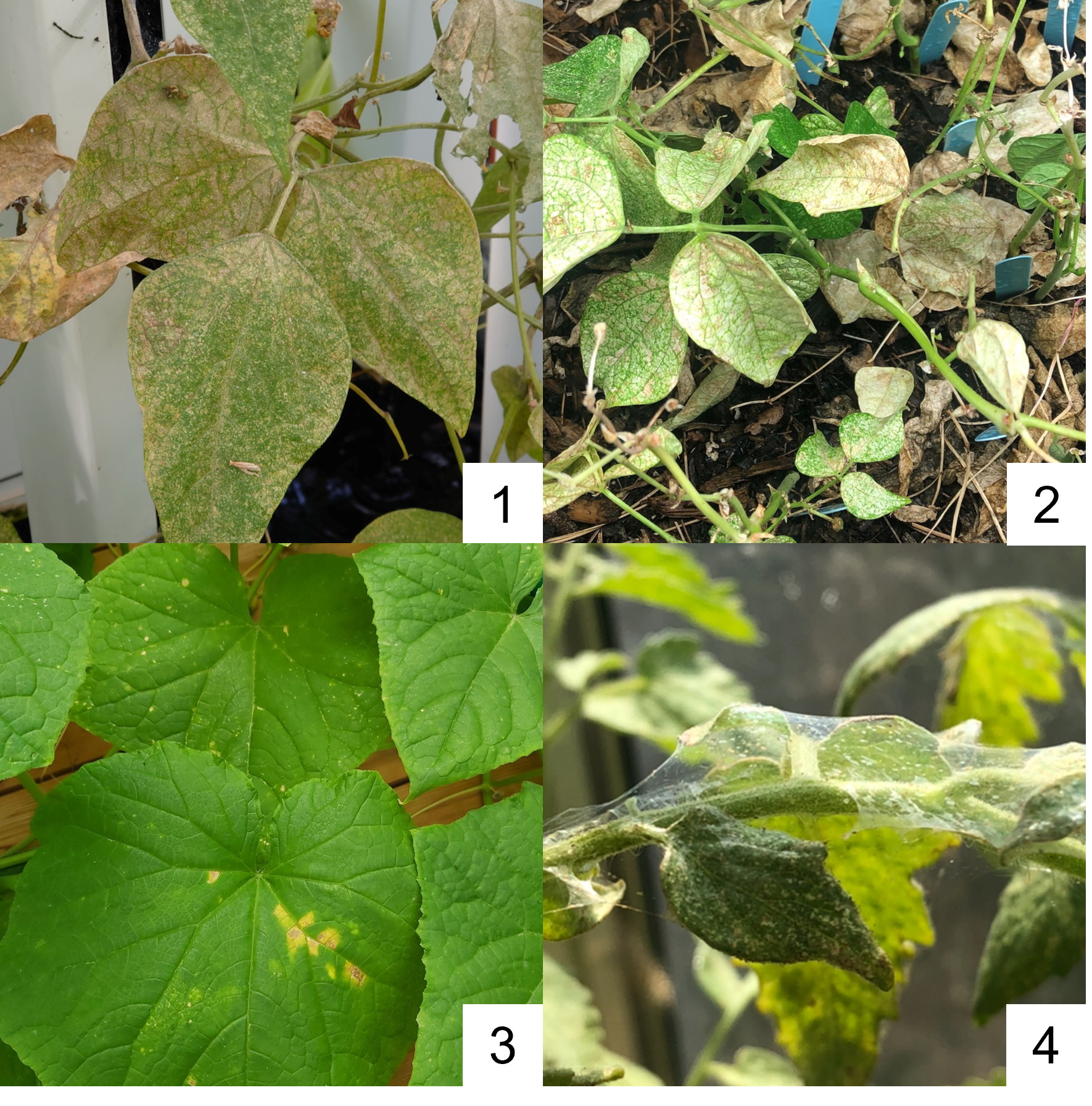
1)Mites on beans in aquaponics: leaves drying out and plant decline.
2)Mites on beans in a permaculture bed: leaves drying out.
3)Mites on cucumber in aquaponics: localised yellowing on the leaf surface (first symptoms appearing).
4)Mites on tomatoes in a permaculture bed: webbing around the leaves (extreme attack).
Damage to crops: HIGH
- Total drying out of the plant, then decline
- Impact on yield
- Fast contamination of plants near the infection
Control actions1) Thoroughly soak the leaves with cold water to remove the mites, which cannot tolerate water.
2) Remove all affected parts by cutting them off, or even remove the whole plant if it is completely infested.
3) Spray the rapeseed oil-based solution on all sides of the leaves. Diluted nettle manure can also be used.
4) Set up integrated pest management in your greenhouse
2. WHITEFLIES (Tomatoes, Cucumbers, Aubergines)
Whiteflies look like small white flies with triangular wings. They are sensitive and fly away when the plant is touched.
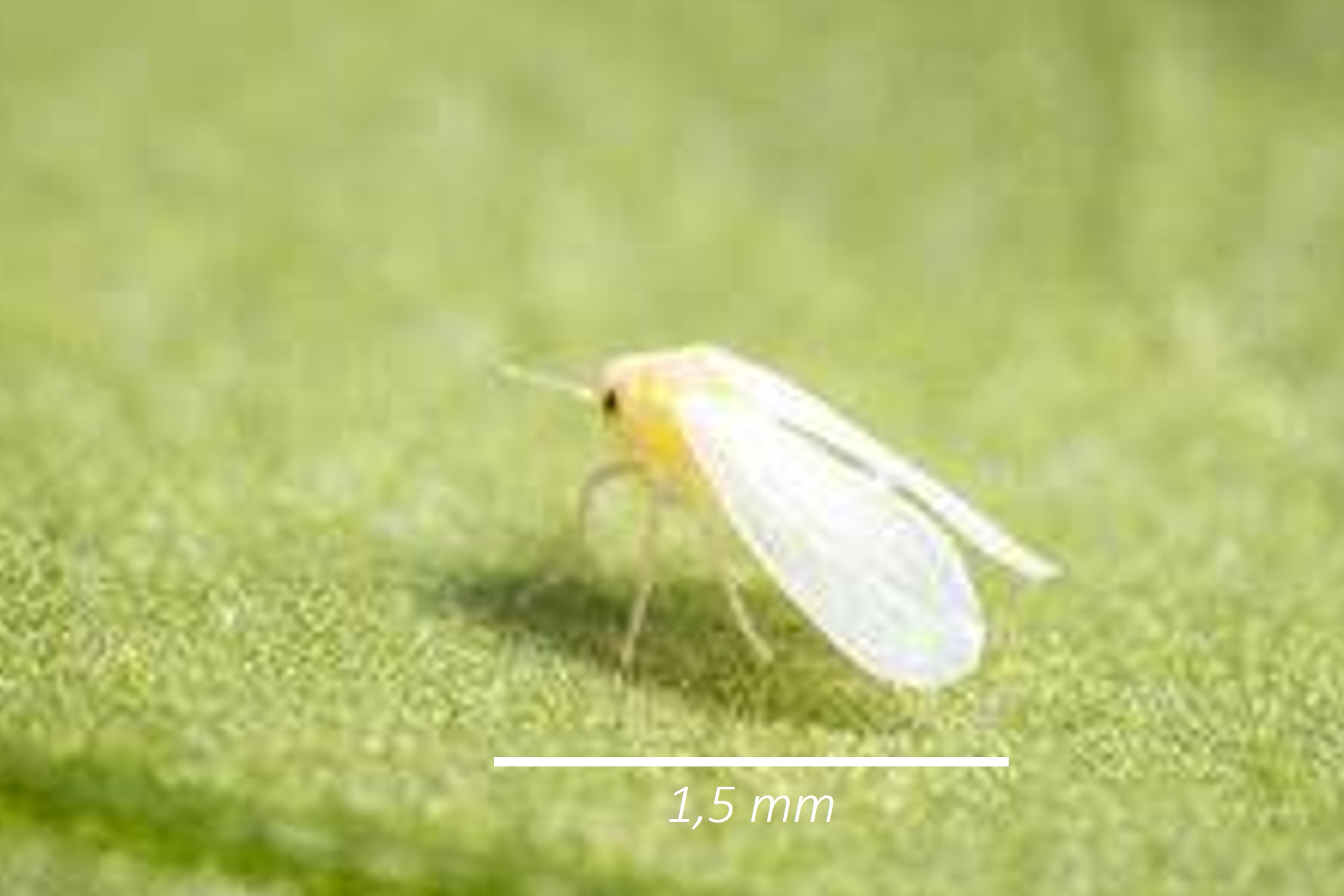
Photo of a whitefly (source: Koppert)
IDENTIFICATION SHEET
Size Less than 2mm
Location Under the leaves on the upper part of the plant
Target crops Tomatoes, Cucumbers, Aubergines, Peppers
Pest stage Larva (transparent), pupa and adult.
Climate Ambient (temperature 20°C) - April to October
Spread From one plant to another by flying.
Harm threshold About ten whiteflies on one plant
Symptoms observed by pioneers
- Presence of small white flies mainly on the underside of the leaves. There may also be some on the upper side of the leaves when the population is dense.
- Swarms of small flies when the plants are brushed.
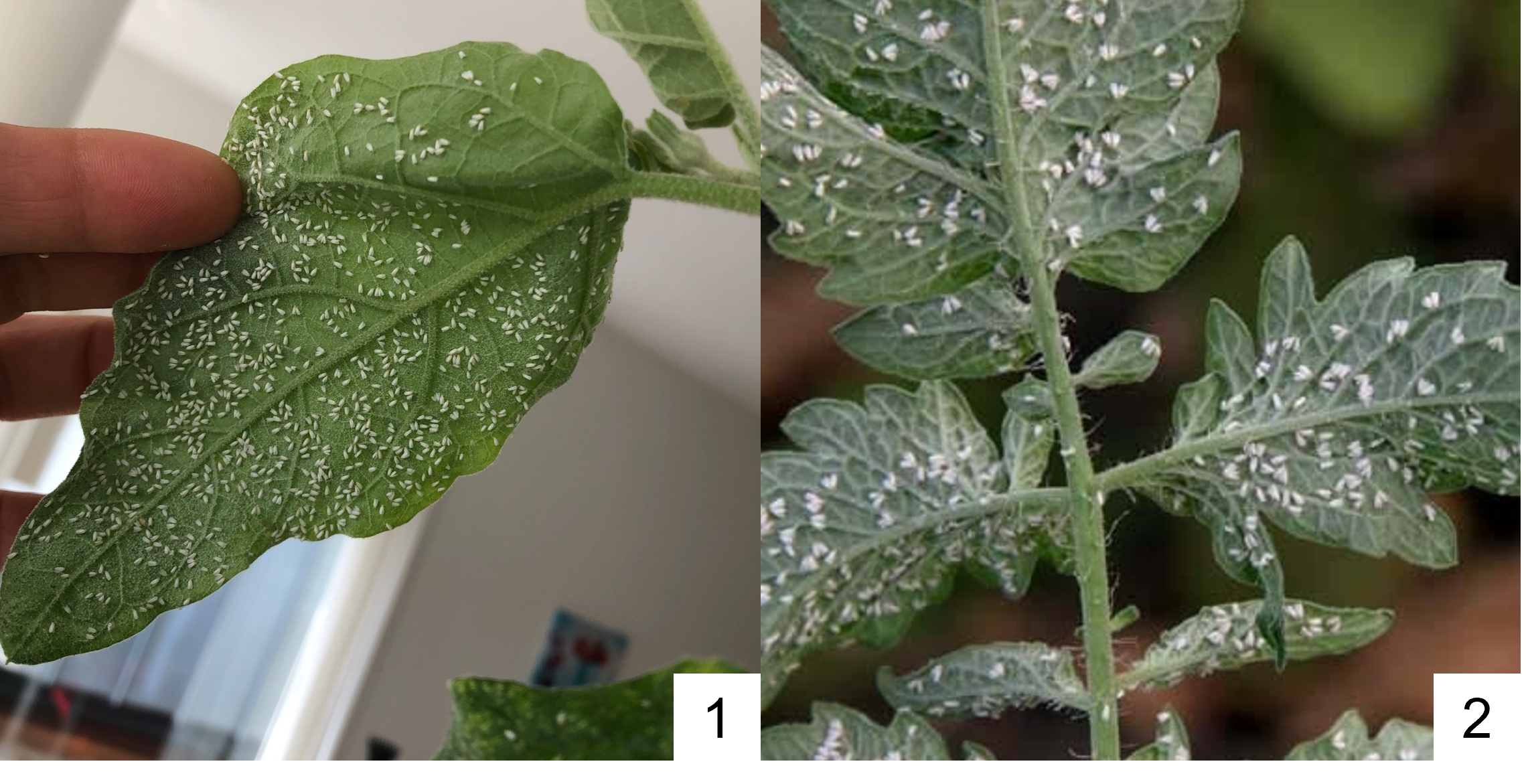
1)Whiteflies under an aubergine leaf in Aerospring.
2)Whiteflies under a tomato leaf.
Damage to crops: HIGH
- Stunted growth
- Impact on yield: fruit abortion
Control actions1)Install sticky traps in the greenhouse to trap flying adults
2) Vacuum the affected plants
3)Spray the black soap-based solution**In aquaponics, it is recommended to take the vertical growing towers out to apply this treatment.
3. CATERPILLARS (Cabbages and leafy vegetables)
Caterpillars enter the greenhouse in butterfly form. Depending on their appearance, they may be moths, cabbage whites or owlet moths. They all have one common goal: mainly to devour cabbage leaves.
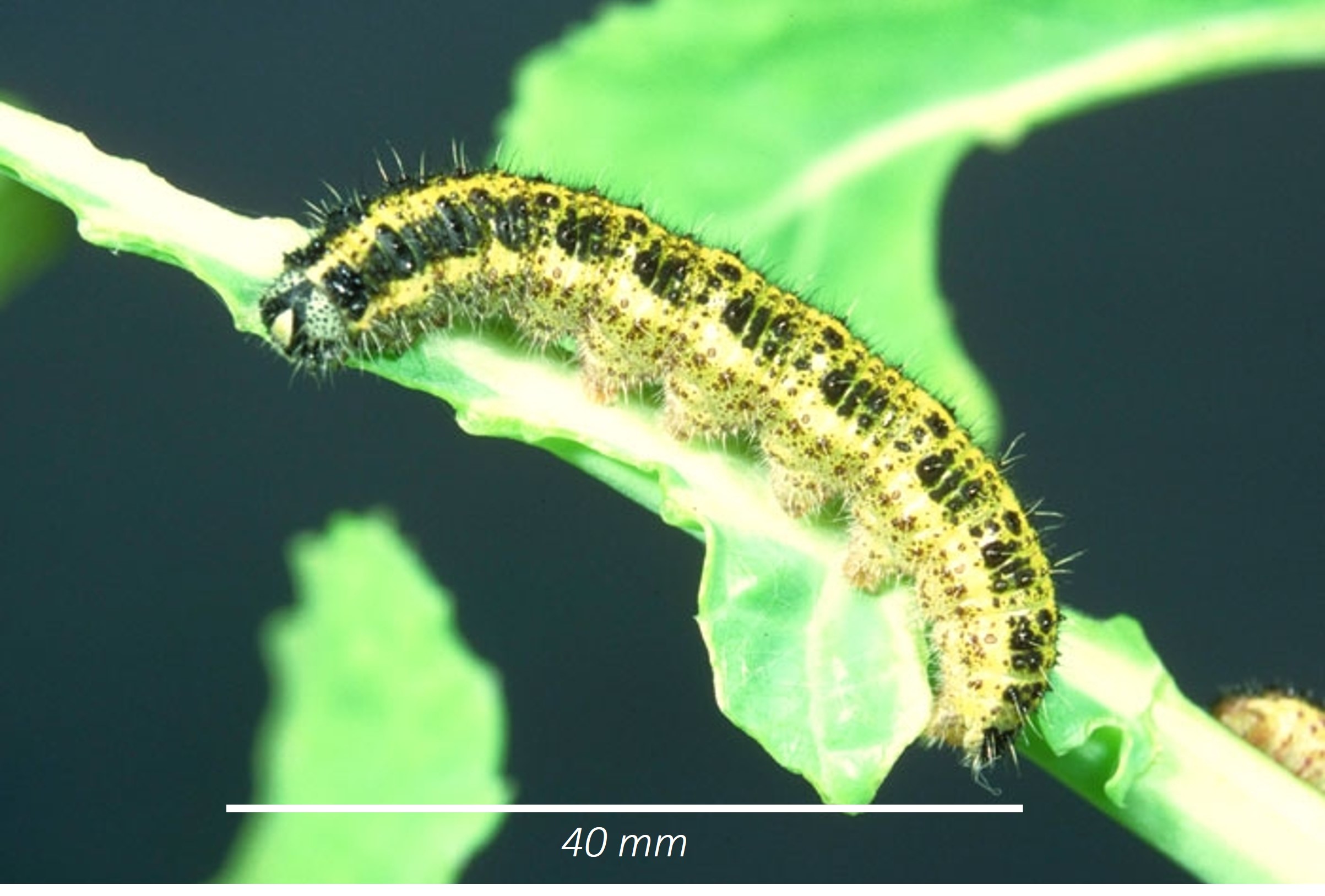
Photo of a caterpillar (source: INRA)
IDENTIFICATION SHEET
Size Caterpillars about 3cm, butterflies
Location On leaves, stems
Target crops Cabbages
Pest stage Larva
Climate Temperate (between 10 and 30°C) - All year round.
Spread The butterfly enters the greenhouse and lays its eggs on the plant.
Colonisation The larvae move on the plant and from one plant to another by contact.
Harm threshold Presence of caterpillars or leaf damage on at least 2 plants.
Symptoms observed by pioneers
- Holes in the leaves
- Presence of small shiny black balls on the leaves: these are their droppings
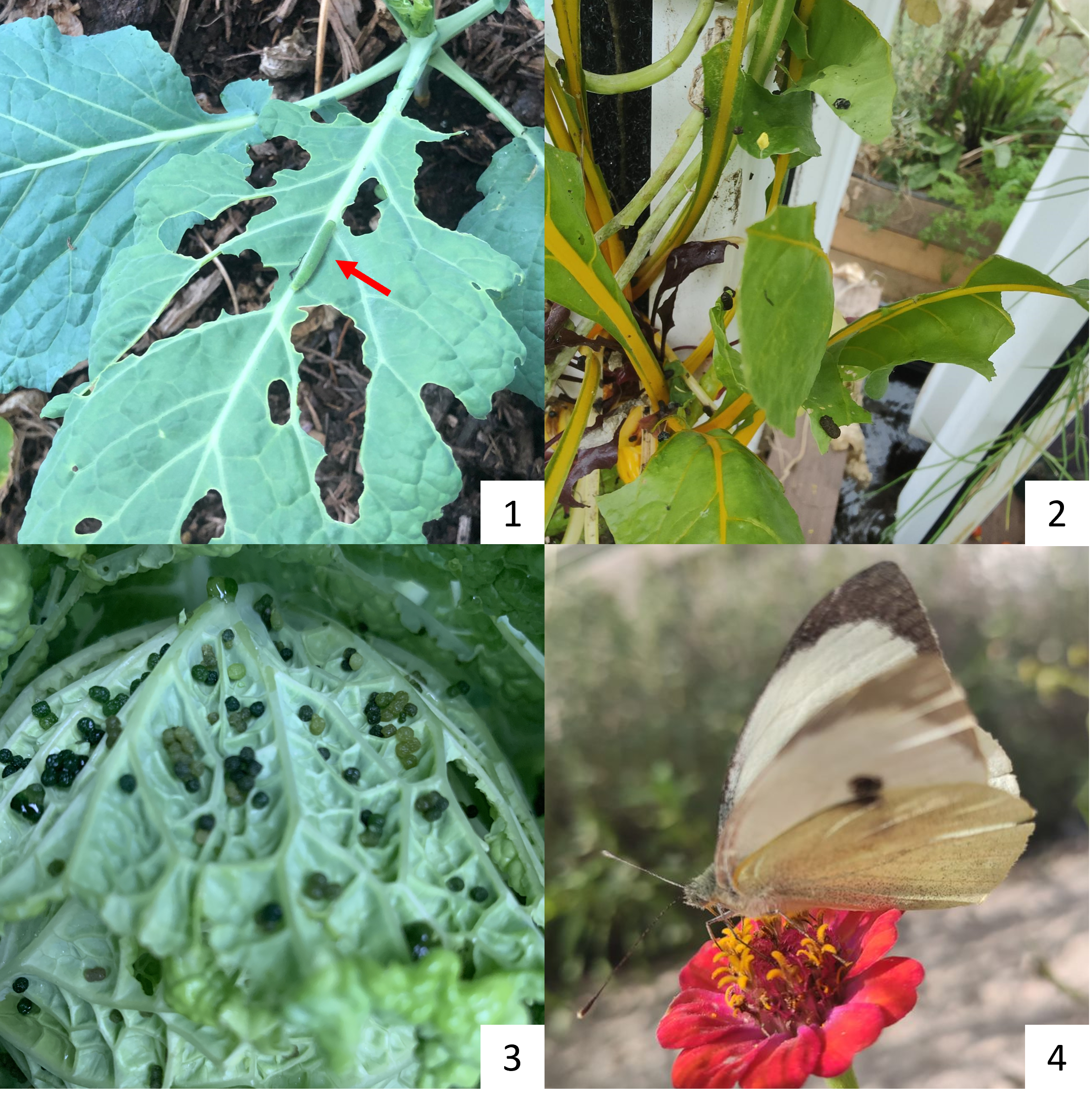
1)Caterpillar on kohlrabi in a permaculture bed.
2)Chard leaves affected by caterpillars in aquaponics.
3)Caterpillar droppings on cabbage leaves in aquaponics.
4)Butterfly form
Damage to crops: MEDIUM
- Plant growth stops
- Impact on yield, no harvest
Control actions1) Remove and crush the caterpillars from attacked plants
2) Spray a Bacillus thuringiensis-based solution on the cabbage leaf parts
4. LEAF MINERS (Leafy vegetables)
Leaf miner larvae develop inside the leaves and dig characteristic tunnels.
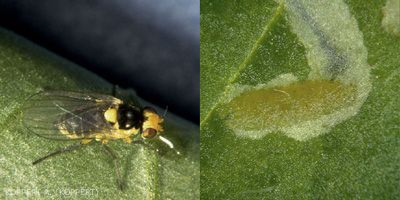
Photo of the leaf miner stages. On the left, the adult stage. On the right, the larval stage
IDENTIFICATION SHEET
Size Less than 2mm
Location Inside the leaves (under the outer layer).
Target crops Lettuces, chicories, beans, chard, spinach...
Pest stage Larva.
Climate Temperate (between 10 and 30°C) - All year round.
Spread The fly (adult form) lays its eggs directly in the leaves.
Colonisation The larvae move within the plant, going from one leaf to another through the stem. They cannot attack another plant.
Harm threshold As soon as one tunnel appears on a leaf
Symptoms observed by pioneers
- Characteristic tunnels dug on the underside and/or outer side of the leaf
The larva is visible to the naked eye inside the tunnels.
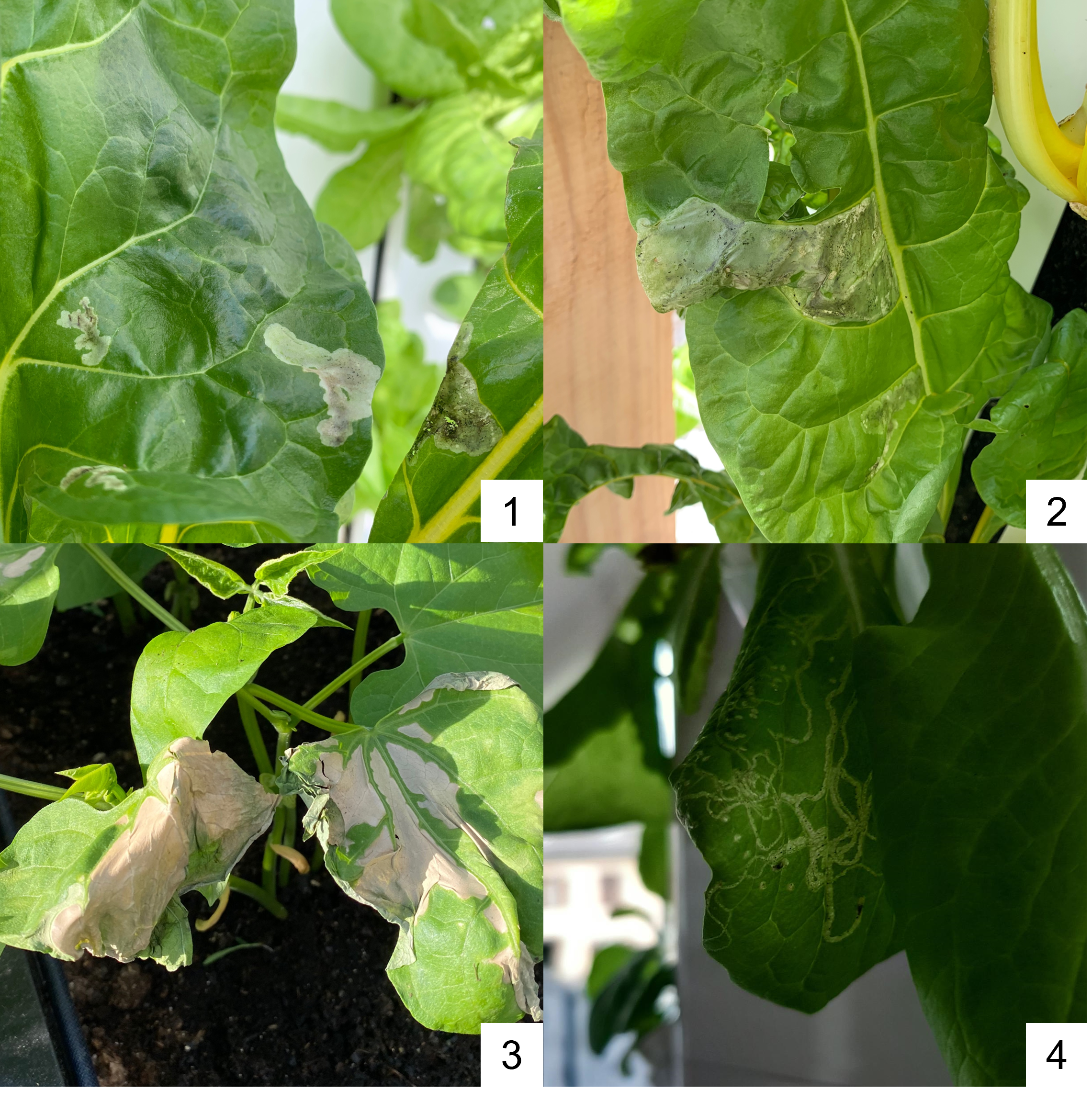
1)Leaf miners on chard in aquaponics.
2)Leaf miners on chard in aquaponics.
3)Leaf miners on bean in a permaculture bed.
4)Leaf miner on lettuce in Aerospring.
Damage to crops: LOW
- Premature wilting of the leaves.
- Little impact on plant yield.
Control actions1) Quickly cut off the affected leaves to avoid spread within the plant.
2) Install sticky traps for detection of winged adults.
3) Spray the rapeseed oil-based solution on the rest of the plant.
4) Stay observant for one week.
5. APHIDS (All crop types)
Aphids are small piercing-sucking insects with an oval shape and a colour that varies depending on the species (generally light to dark green, brown, grey, black...).
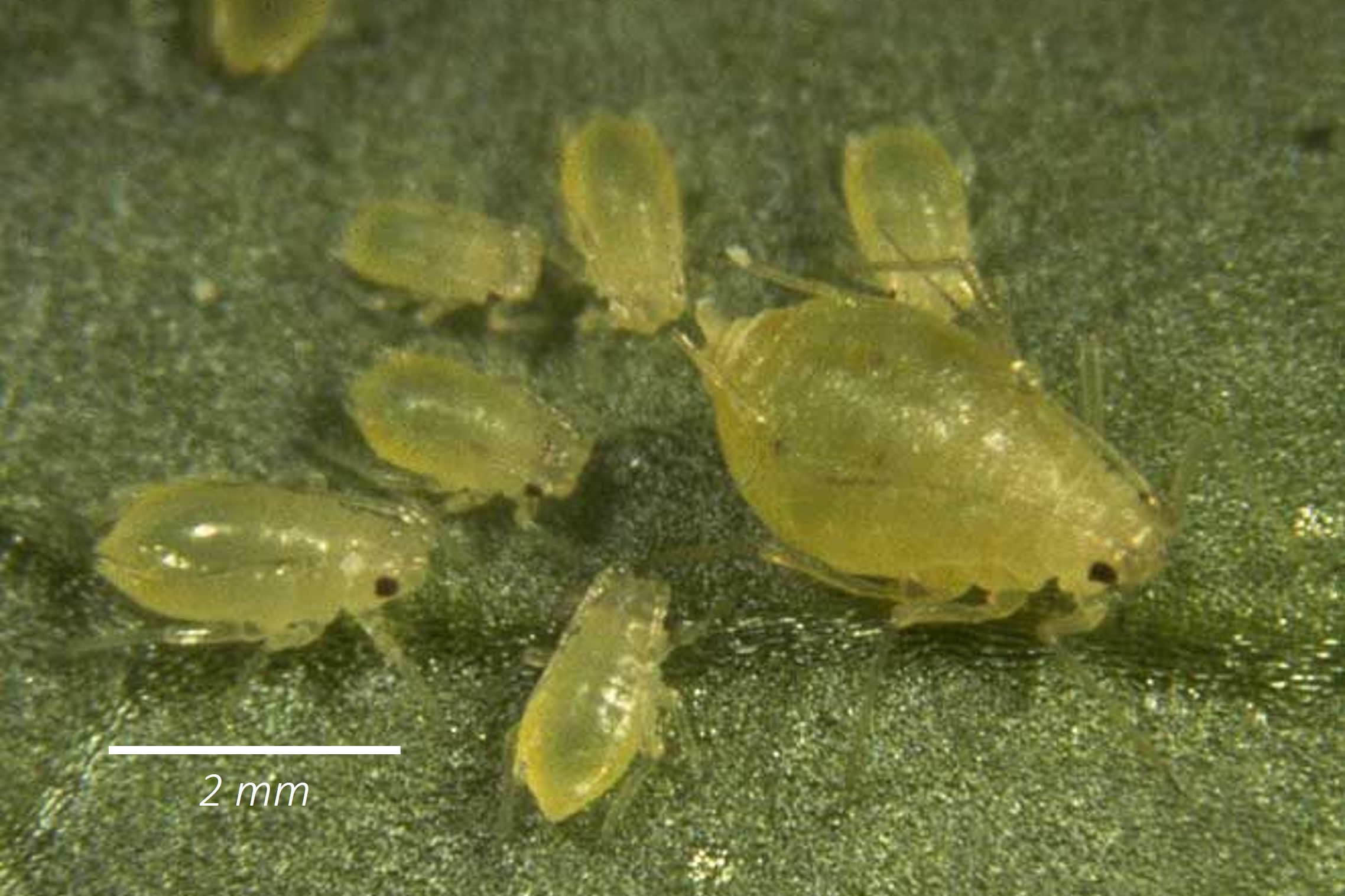
Photo of a colony of Myzus persicae aphids (source: INRA)
IDENTIFICATION SHEET
Size 2 to 4 mm
Location First on the underside of the leaf, then on the upper side.
Target crops Aubergine, pepper, lettuce, celery, chard and other vegetable crops.
Pest stage Young and adult.
Climate Temperate (between 10 and 30°C) - All year round.
Spread Wingless individuals reproduce on the young/weak parts of the plant to exploit its resources. Asexual reproduction allows exponential spread and colonisation of aphids in the greenhouse.
Colonisation As soon as the plant weakens, winged forms appear to contaminate new plants. A wingless individual only moves a few cm to feed throughout its life.
Harm threshold From around ten individuals on one leaf.
Symptoms observed by pioneers
- Presence of white moults and detection of aphids
All aphid development stages can be observed on the plant. The presence of small white exuviae/moults is an indicator of their presence. - Presence of ants
Ants feed on the honeydew secreted by aphids and protect them. - Development of sooty mould
Sooty mould is a blackish fungus that can develop on the leaves following honeydew secretion. Leaves covered with sooty mould can no longer photosynthesise and plant growth is affected.
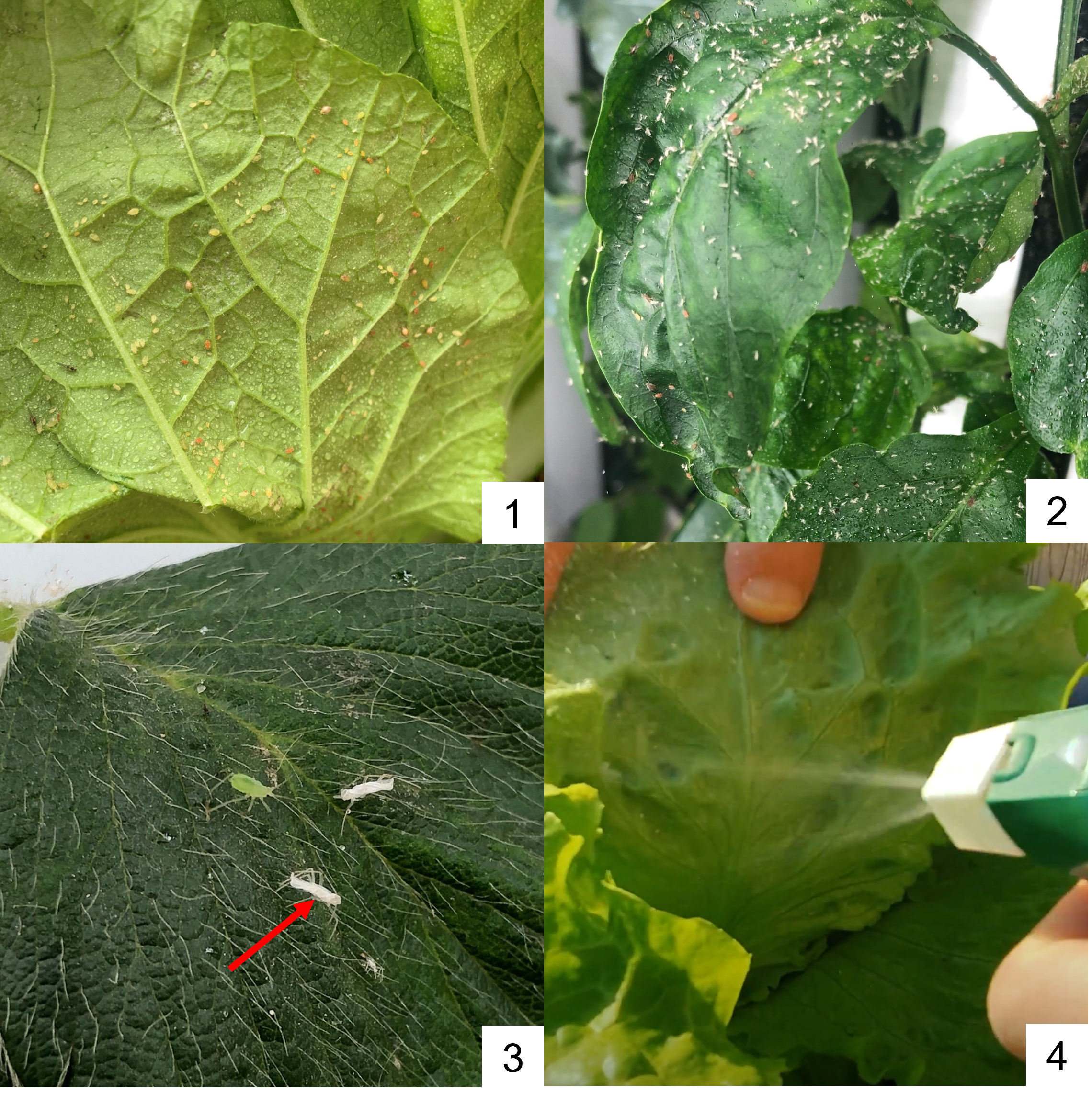
1)Aphids on lettuce (underside of the leaf) in aquaponics.
2)Aphids on a pepper plant in aquaponics.
3)Aphid moult/exuvia on a strawberry plant in Aerospring.
4)Spraying the suitable treatment on lettuce.
Damage to crops: LOW
- Premature wilting of the leaves.
- Deformation of flowers and fruits.
- Little impact on plant yield.
Control actions1) Crush aphids as soon as the first individuals and colonies appear.
2) Spray the rapeseed oil-based solution.
3) Spray the black soap-based solution.
4) Set up integrated pest management in your greenhouse
6. THRIPS (Flowering plants)
Thrips are small yellow insects that are longer than they are wide.
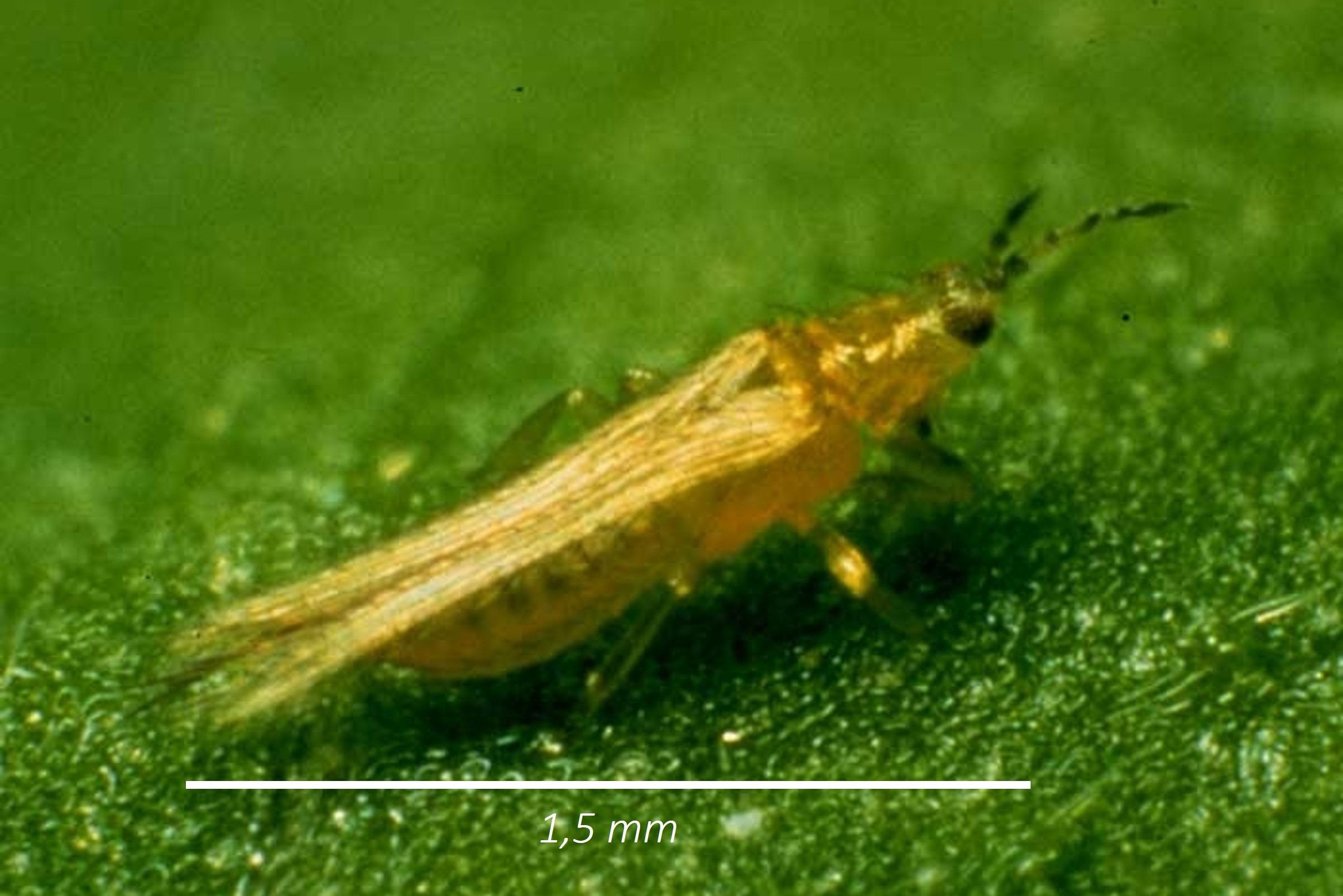
Photo of an adult thrips (source: INRA).
IDENTIFICATION SHEET
Size Less than 2mm
Location On the underside of the leaves.
Target crops Flowering crops: tomatoes, peppers, aubergines, cucumbers...
Pest stage Larva and adult.
Climate Hot (25 to 35°C) - June to August.
Spread The adult form lays its eggs under the leaves and in flower petals.
Colonisation The winged stage allows dispersal from one plant to another.
Harm threshold As soon as grey-silvery spots appear on a leaf.
Symptoms observed by pioneers
- Grey-silvery spots on the leaf surface (similar to necrosis)
- Small black dots on the underside of the leaves near the necrosis: these are thrips droppings.
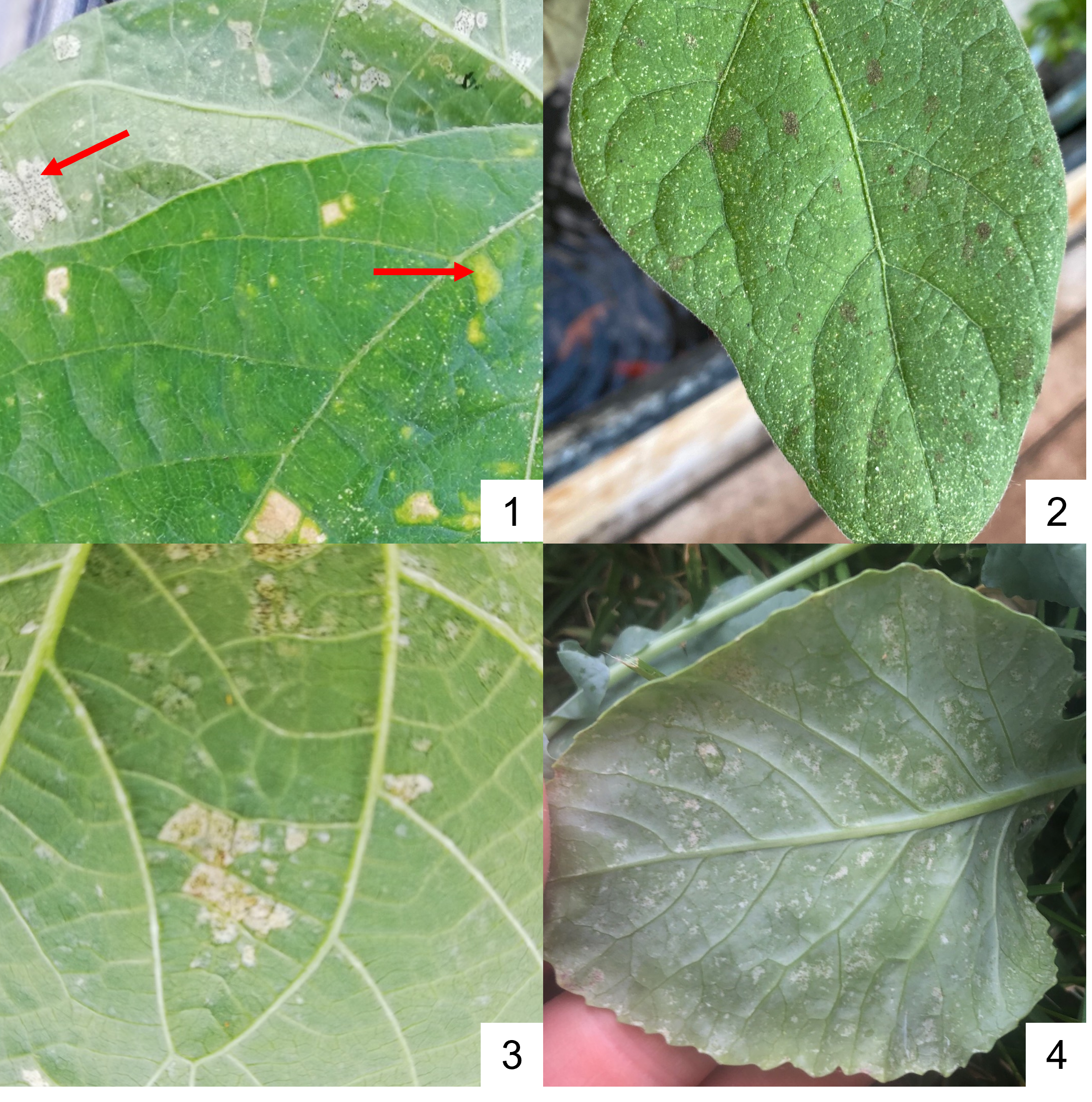
1)Thrips damage on the upper and lower side of a cucumber leaf in aquaponics (top right: black dots under the leaf; middle left: necrosis observed on the leaf surface)
2)Thrips damage on aubergine leaves in aquaponics.
3)Thrips damage on aubergine leaves in bioponics.
4)Thrips damage on the underside of a cabbage leaf in permaculture (silvery spots).
Damage to crops: HIGH
- Browning and drying out of the leaves.
- Reduced plant vigour.
- Damage to flowers and fruits: impact on yield.
- Thrips = virus vector.
Control actions1) Install sticky traps to detect winged stages.
2) Cut off the affected parts.
3) Spray the rapeseed oil-based solution
7. STINK BUGS
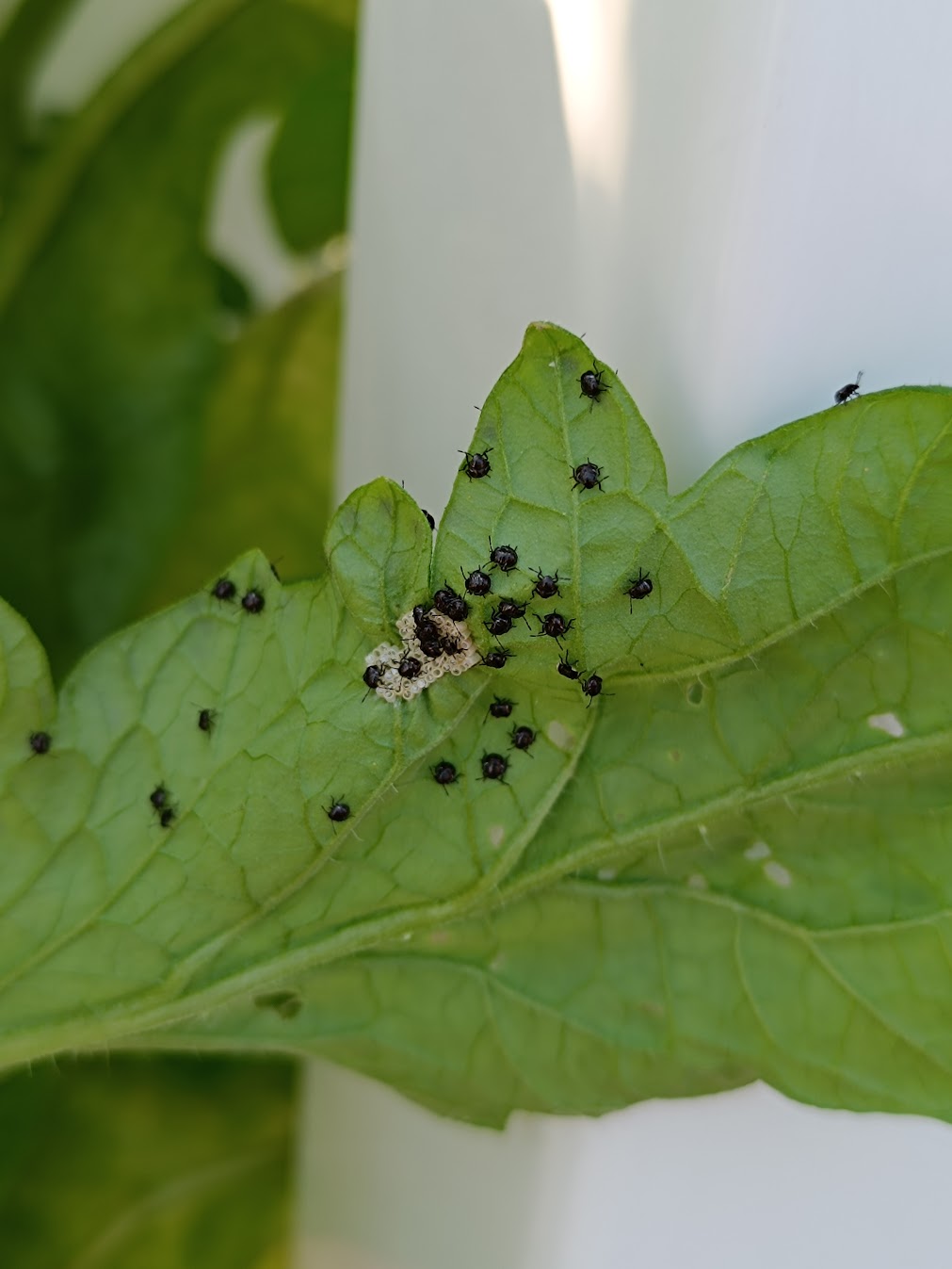
Hatching of eggs from a stink bug colony
IDENTIFICATION SHEET – STINK BUGS
Size : Between 5 and 15 mm, depending on the species.
Location : On leaves, stems and sometimes fruits.
Target crops : Vegetable crops (tomatoes, peppers, aubergines, cucumbers, squashes) and fruit crops.
Pest stage: Larva and adult.
Climate: Temperate to hot (20 to 35°C) – Present mainly from May to September.
Spread: Adults lay eggs on the underside of the leaves. The larvae hatch after a few days and immediately begin feeding.
Colonisation: Winged adults move from one plant to another, promoting rapid spread.
Harm threshold: As soon as punctures and deformities appear on leaves and fruits.
Symptoms observed by pioneers
- Yellowish punctures on the leaves, often in small groups.
- Deformation of young shoots and fruits (bumpy or misshapen appearance).
Control action
- Coloured sticky traps: stink bugs are attracted to certain colours, such as yellow. Use sticky traps of this colour to catch them.
- Plant aromatic herbs such as mint, basil or rosemary around your greenhouse or in pots (for mint and rosemary). These plants can repel stink bugs. Marigold flowers (Tagetes) - one plant per tower or one per bed - and petunia are also known to be natural repellents.
- Attract natural predators of stink bugs, such as ladybirds / ladybugs, earwigs or spiders, by creating a favourable habitat. For example, keep planting nectar-rich flowers such as borage or phacelia to attract these beneficial insects. If treatment is needed, black soap remains effective against stink bugs.
Other insects/pests
In the greenhouse, it is possible to find other harmful or harmless insects that do not appear in the list above.
-
Ants
To keep them away from your crops, here are the treatments to put in place: -
Mix coffee grounds directly into the substrate of the permaculture beds or place a small amount on ant trails.
-
Sprinkle diatomaceous earth near their trails
-
Use essential oils; peppermint is effective against ants
-
Gnats can be found in the greenhouse. This is often due to excess humidity in the greenhouse (mainly in winter).
We recommend temporarily turning on ventilation, installing sticky traps for trapping, and treating with a rapeseed oil-based solution as for aphids, mites, thrips... -
Scale insects can attack plants. Treatment advice: dilute in 1L of water, 1 tsp of liquid black soap, 1 tsp of vegetable oil and 1 tsp of 90° alcohol. Spray this solution 1 time per day for 3-4 days.
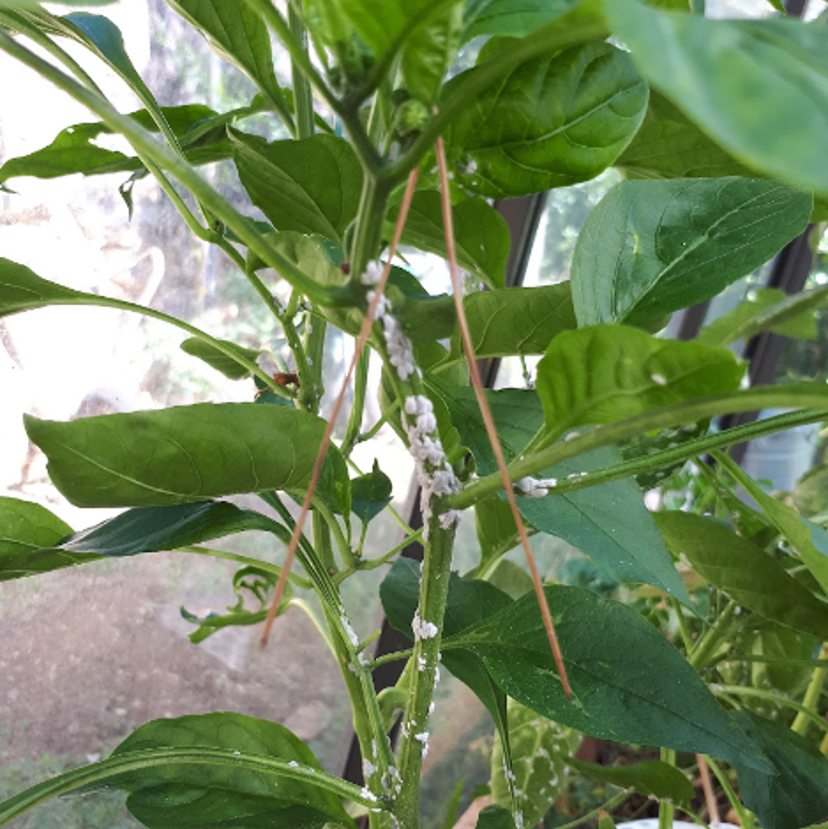
Photo of scale insects on a pepper plant in a permaculture bed.