
Fill the tanks
An important step for balancing biological interactions.
1. Water level
Family greenhouse
Minimum water level: 5 cm below the ring of the submerged filter
Maximum water level (ideal): below the ring of the submerged filter
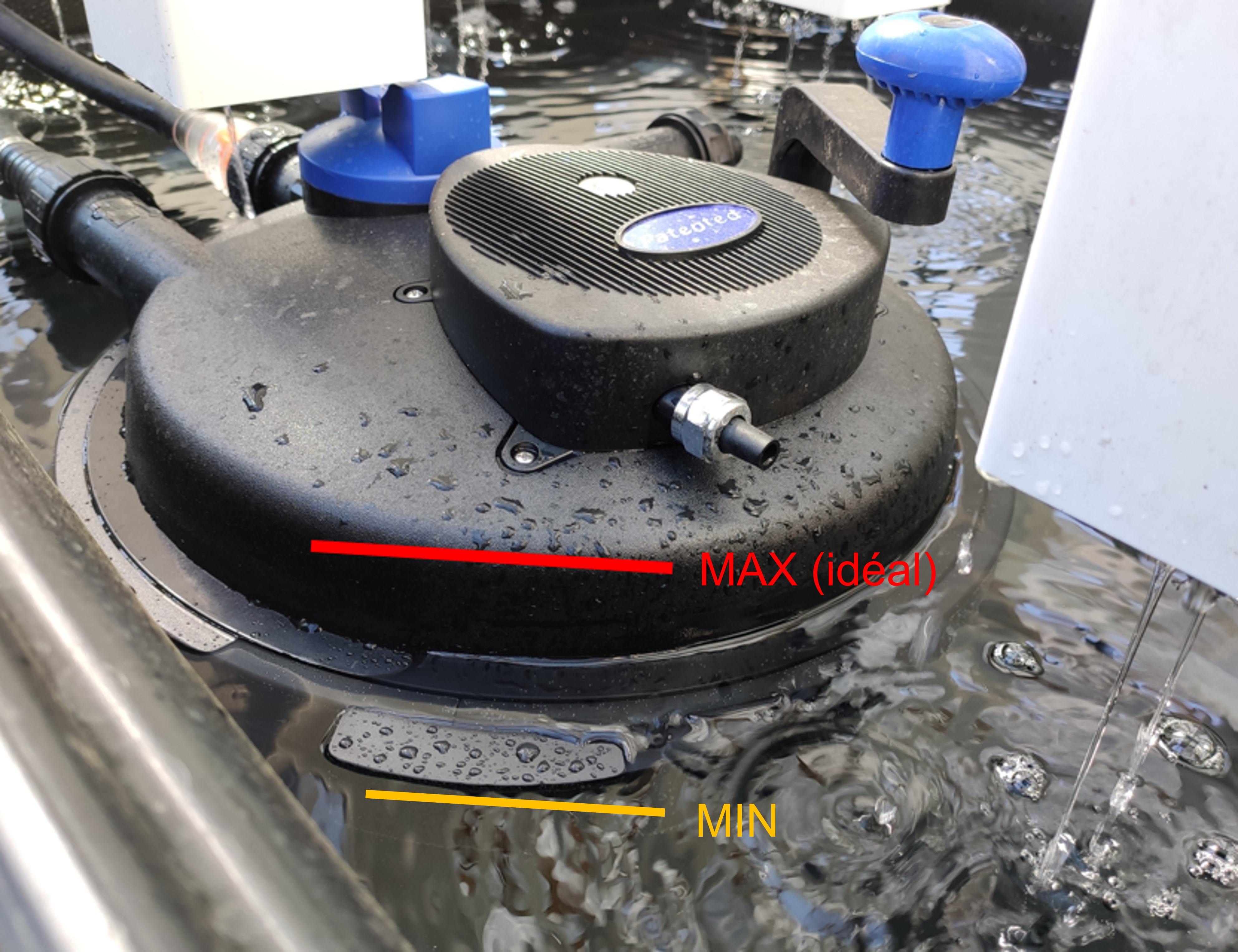
Water level in the fish tanks for the Family greenhouse
City greenhouse
Minimum water level: 20 cm below the top of the tank
Maximum water level (ideal): 5 cm below the top of the tank (the bottom of the 3 towers above the tank is submerged)
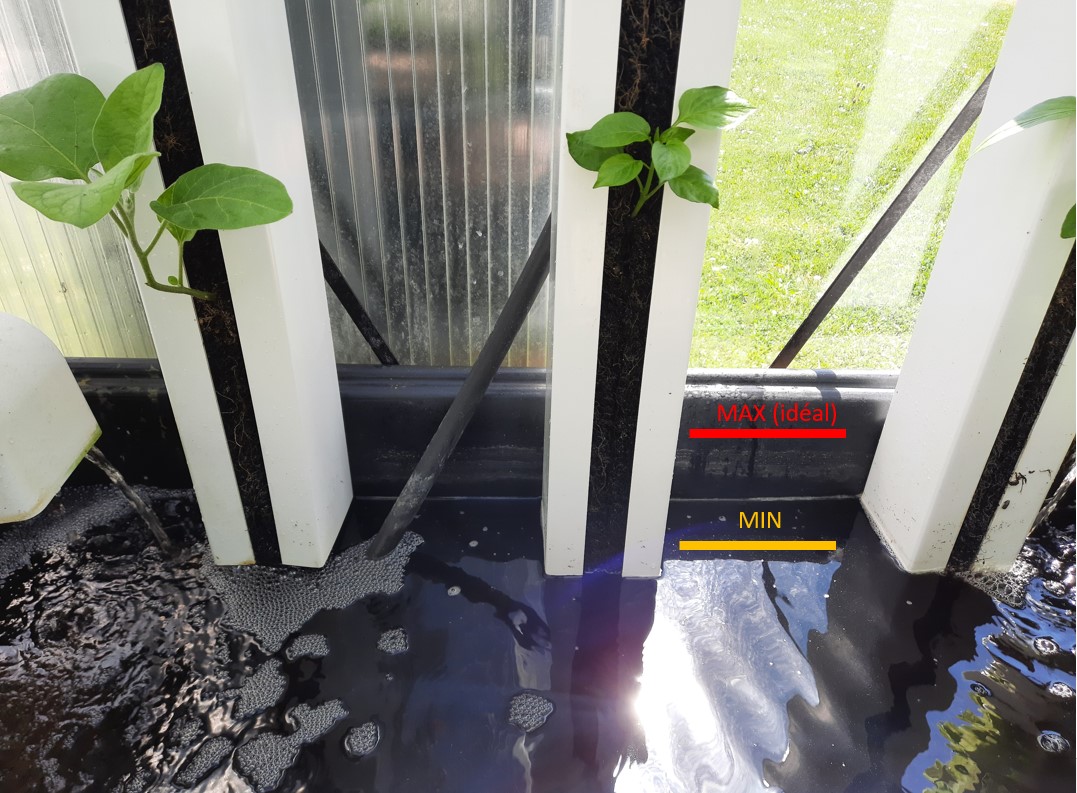
2. Types of water to use
TipWhile waiting for your greenhouse installation, you can start by testing the water source you want to use to fill your fish tanks.
If possible, start storing rainwater so you can meet the fish tank filling conditions as soon as the installation is complete.
Using a test strip or a drop test, determine the carbonate hardness value (KH) of the water:
- KH < 3°d: the water is free of carbonates and is too soft. It can be used in combination with harder water (mains water).
- 4°d < KH < 5°d: the water is soft and contains enough carbonates. It can be used to fill the fish tanks.
- KH > 6°d: the water is hard and contains too many carbonates. It can be used in combination with softer water (reverse osmosis water or rainwater).
| Type of water | Average KH carbonate hardness |
|---|---|
| Reverse osmosis water | 3°d |
| Rainwater (stored in a plastic tank) | 4°d |
| Tap water | 12 à 14°d |
| Rainwater (stored in a concrete tank) | 15°d |
| Hard water | 15°d |
| Well/borehole water | > 20°d |
Summary table of the average carbonate hardness of the different types of water available to you. These values are provided for guidance only and do not replace the value shown on your test strip.
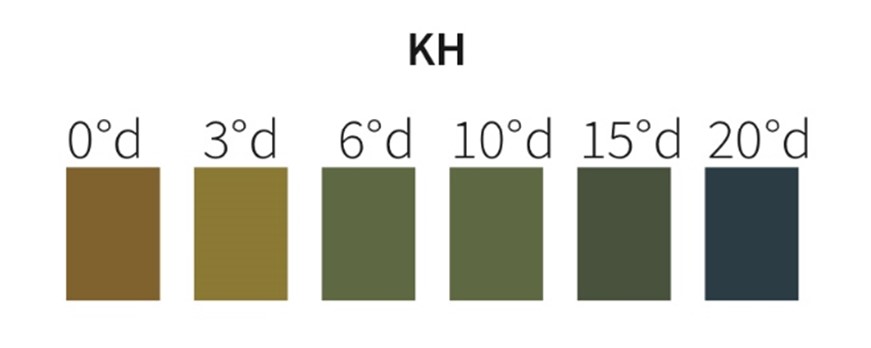
Colorimetric scale of carbonate hardness. The ideal KH is between 4 and 5°d.
3. Proportions for filling the fish tanks
As soon as the greenhouse installation is complete, you can fill the fish tanks and, in parallel, start the cycling process.
Here are our recommendations for filling:
- 2/3 soft water (KH<5°d) = rainwater or reverse osmosis water
- 1/3 hard water = tap water
It is essential to follow these proportions to establish the symbiosis between bacteria, plants and fish.
These proportions will also allow you to stabilize the environment and subsequently obtain a pH that remains stable over time.
Tap water contains essential minerals for bacterial development. It brings carbonates into the environment, which are necessary to stabilize the pH and create a suitable environment for your fish.
DO NOT DO THISDo not fill the fish tanks exclusively with tap water.
Do not fill the fish tanks exclusively with rainwater.Consequences:
- Complications in managing KH and pH parameters
- Longer cycling time
- Delay in plant establishment and fish introduction
Pump operation
- The pump and the air pump must be running continuously from the start, even before the plants and fish arrive.
- The cycling process relies on microbial activity inside the growing towers and requires water circulation and continuous oxygenation.
- During filter maintenance operations, the pump can be switched off occasionally.
4. Adding the cycling components
As soon as the fish tanks are filled and the pump is running continuously, you can start the cycling process at the same time to establish the bacteria in the water.
If you have any other questions about filling the fish tanks, contact us directly at [email protected].
5. Managing water in the fish tanks
Managing the fish tanks in a growing system is essential to ensure the installation operates correctly and to maintain the health of both plants and fish. Here are a few key points to monitor to guarantee system efficiency.
- Maintain the correct water level in the fish tanks. An adequate water level ensures the proper operation of the entire irrigation system.
- Make sure that neither plants nor fruits are soaking in the water. If plants or fruits fall into the fish tanks, this could eventually lead to rot problems or contaminate the water.
- Monitor the roots: they must not become too invasive, because roots that are too long or too dense can disrupt the balance of the tank and affect plant health.
- The fish tanks are connected, which allows automatic regulation of the water level. The top-up can therefore be done in a single tank to adjust the whole system. However, if this regulation does not work properly, you can intervene by removing the plug from the outlet pipe of the tanks to help restore the balance.