
Grow in bioponics
Feed the plants using microorganisms and organic fertilizers.
Bioponics is a soilless growing method based on the use of soluble organic fertilizers for plant growth.
The ZipGrow vertical growing tower system is suitable for two growing methods: bioponics and aquaponics. In both cases, it is a natural growing process. Micro-organisms introduced into the water work to provide the roots with the minerals needed for plant growth.
Bioponics is the fish-free growing method. Plants are fed with organic fertilizers (nettle manure, wood ash, etc.) and animal droppings (bat guano) introduced directly into the water.
This choice is not irreversible: you can switch to aquaponics whenever you want by following these recommendations.
Check our fundamentals and discover the aquaponics glossary and the importance of the nitrogen cycle.
1. Start cycling – MANDATORY
Growing your plants in bioponics absolutely requires starting cycling to establish the beneficial bacteria for the nitrogen cycle in the water.
Find all the information about cycling here.
As soon as cycling has started(1), you can start growing your plants and begin adding fertilizers and growing auxiliaries.
(1) On your strip test, you observe a pink colour on the NO3- and NO2- pads.
2. Use bioponic fertilizers
Plants need minerals and trace elements for growth and to produce fruit and vegetables. These are supplied by organic biological fertilizers.
Bioponic growing is very easy to set up!
Instead of fish waste, an organic biological fertilizer is added regularly to the water in the form of two liquid solutions, GROW and BLOOM.
These bioponic fertilizers formulated by BioSevia are “food” for the plant.
The GROW formula is designed to improve plant growth and vegetative development (stems, leaves) and roots. The leafy parts of plants require a lot of nitrogen; the GROW solution guarantees optimal nutrition suited to meeting their needs.
The BLOOM formula is designed to support flowering and fruiting. It provides the trace elements, including potassium, required for flower and fruit formation.
BioSevia offers the first fully soluble biological fertilizers. They are made from beet vinasse, wood ash extracts, vermicompost juice and other mineral extracts approved for organic production.
3. Introduce beneficial microorganisms
Plants take up nutrients from the water using their roots and the root hairs located at their tips.
Some mycorrhizal fungi develop in symbiosis with the plant root network. They therefore develop like root extensions, increasing the root exploration surface area by 100. The plant is then better able to take up all the nutrients and minerals it needs for growth.
These microorganisms are naturally present in soil but absent from the irrigation solution used in bioponics. They must be introduced regularly to guarantee optimal plant growth.
The biological root activator contains Azospirillum sp and glomus intraradicesi, beneficial bacteria and fungi that act directly on the root system. It protects roots, improves plant nutrition and nutrient availability, and promotes denser root hair development for better plant establishment.
- Mycorrhizal fungi (glomus intraradicesi) allow optimal mineral nutrition for the plant by considerably increasing the root absorption surface area.
- Beneficial bacteria (Azospirillum sp) stimulate root growth, improve nutrient availability and strengthen plant establishment after planting.
4. Our recommendations
To avoid deficiencies in your bioponic system, we recommend regularly adding inputs (fertilizers and auxiliaries) to the water.
By following the recommendations in the tables below, you ensure optimal growing conditions for your fruits and vegetables all year round.
STEP 1: start-up phase (cycling)
To add nitrifying bacteria and ammonium sulfate to your system.
| CITY Model | FAMILY Model - 1 fish tank | FAMILY Model - 2 fish tanks | FAMILY Model - 3 fish tanks | |
|---|---|---|---|---|
| DAY 1 - Ammonium sulfate quantity | 8 g = 2 teaspoons | 20 g = 2 tablespoons | 50 g = 4 tablespoons | 80 g = 6 tablespoons |
| DAY 1 - Bacteria quantity | 1 measuring spoon | 2 measuring spoons | 4 measuring spoons | 6 measuring spoons |
| DAY 1 - Iron chelate quantity | 1 teaspoon | 2 teaspoons | 3 teaspoons | 5 teaspoons |
| DAY 14 - Ammonium sulfate quantity | 8 g | 20 g | 50 g | 80 g |
STEP 2: production phase (pH 5,5 to 6)
As soon as plants are put into cultivation, bioponic fertilizers and the root activator must be introduced regularly into your system. The products must be diluted or dissolved.
Below you will find the quantities, frequencies and methods for additions depending on the season.
CITY Model
The root activator should be added after each new planting OR once in spring and then every 3 months.
| CITY Model | SPRING-SUMMER From March to October Every 2 weeks | AUTUMN-WINTER From October to March Every 4 weeks |
|---|---|---|
| GROW fertilizer | 50 mL | 100 mL |
| BLOOM fertilizer | 50 mL | |
| Calcium | 50 mL | 50 mL |
| Biological root activator | 2 tablets/fish tank | 2 tablets/fish tank |
| Chelated iron | 0,5 teaspoon | 0,5 teaspoon |
FAMILY Model - 1 fish tank
The root activator should be added after each new planting OR once in spring and then every 3 months.
| FAMILY Model - 1 fish tank | SPRING-SUMMER From March to October Every 2 weeks | AUTUMN-WINTER From October to March Every 4 weeks |
|---|---|---|
| GROW fertilizer | 75 mL | 150 mL |
| BLOOM fertilizer | 75 mL | |
| Calcium | 75 mL | 75 mL |
| Biological root activator | 3 tablets/fish tank | 3 tablets/fish tank |
| Chelated iron | 0,5 teaspoon | 0,5 teaspoon |
FAMILY Model - 2 fish tanks
The root activator should be added after each new planting OR once in spring and then every 3 months.
| FAMILY Model - 2 fish tanks | SPRING-SUMMER From March to October Every 2 weeks | AUTUMN-WINTER From October to March Every 4 weeks |
|---|---|---|
| GROW fertilizer | 150 mL | 300 mL |
| BLOOM fertilizer | 150 mL | |
| Calcium | 100 mL | 100 mL |
| Biological root activator | 3 tablets/fish tank | 3 tablets/fish tank |
| Chelated iron | 1 teaspoon | 1 teaspoon |
FAMILY Model - 3 fish tanks
The root activator should be added after each new planting OR once in spring and then every 3 months.
| FAMILY Model - 3 fish tanks | SPRING-SUMMER From March to October Every 2 weeks | AUTUMN-WINTER From October to March Every 4 weeks |
|---|---|---|
| GROW fertilizer | 225 mL | 450 mL |
| BLOOM fertilizer | 225 mL | |
| Calcium | 150 mL | 150 mL |
| Biological root activator | 3 tablets/fish tank (max 6 tablets) | 3 tablets/fish tank (max 6 tablets) |
| Chelated iron | 1,5 teaspoons | 1,5 teaspoons |
Addition method - GROW, BLOOM and calcium fertilizersPour the fertilizers directly into the water in your tanks, close to each other, one after the other.
To boost the root development of your plants and improve their nutrition, we recommend adding root activator at the same frequency as the organic fertilizers.
Addition method - root activatorsUnlike fertilizers, the root activator must not be introduced directly into the tank water. It must be diluted and then added through the black nozzle.
- Dissolve the root activator tablets in 200 mL of water using the measuring jug
- In the greenhouse, stop the pump, open the black nozzle at the filter outlet
- Pour the mixture directly into the black nozzle, close it again and restart the pump
Thanks to this method, the micro-organisms will establish themselves directly in the matrix of your growing towers, as close as possible to the roots, and improve the growth of your plants.
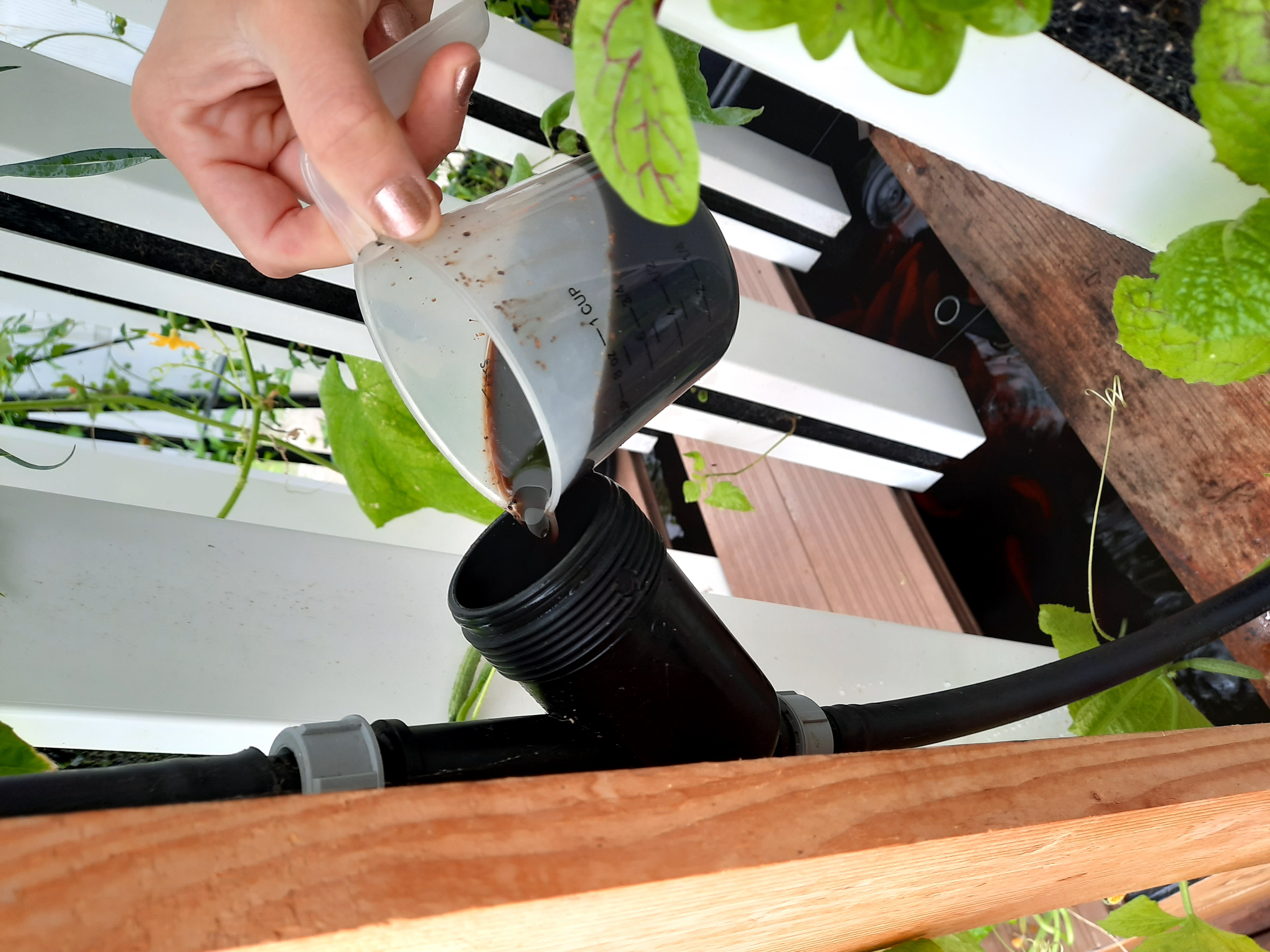
Adding the root activator through the sieve nozzle.
Leafy vegetables and fruiting vegetablesBetween March and October, you will grow mostly fruiting vegetables (aubergine, tomato, cucumber, courgette, etc.) but also some leafy vegetables (lettuce, chicory, spinach, chard, onion, etc.). During this period, it is necessary to add GROW for leaf, stem and root growth, but also BLOOM for flower and fruit formation.
Between October and March, you will grow exclusively leafy vegetables requiring only GROW.
Growing in bioponics in summer
At peak season and depending on the types of plants installed, plants have higher nutrient requirements. Fertilizer quantities may change if deficiencies appear and/or plant growth slows down.
From June to August, fertilizers can be added according to the recommendations indicated below:
| Compounds \ Greenhouse type | City Model | FAMILY Model - 1 fish tank | FAMILY Model - 2 fish tanks | FAMILY Model - 3 fish tanks |
|---|---|---|---|---|
| GROW fertilizer | 100 mL | 150 mL | 300 mL | 450 mL |
| BLOOM fertilizer | 100 mL | 150 mL | 300 mL | 450 mL |
| Iron | 0,5 teaspoon | 0,5 teaspoon | 1 teaspoon | 1,5 teaspoons |
| Calcium chloride | 50 mL | 75 mL | 100 mL | 150 mL |
| Root activator | 2 tablets/ fish tank | 3 tablets/fish tank | 3 tablets/fish tank | 3 tablets/fish tank (max 6 tablets) |
If you have any other questions about growing in bioponics, contact us directly at[email protected].