
gerer-acidite2
1. The ideal pH in aquaponics
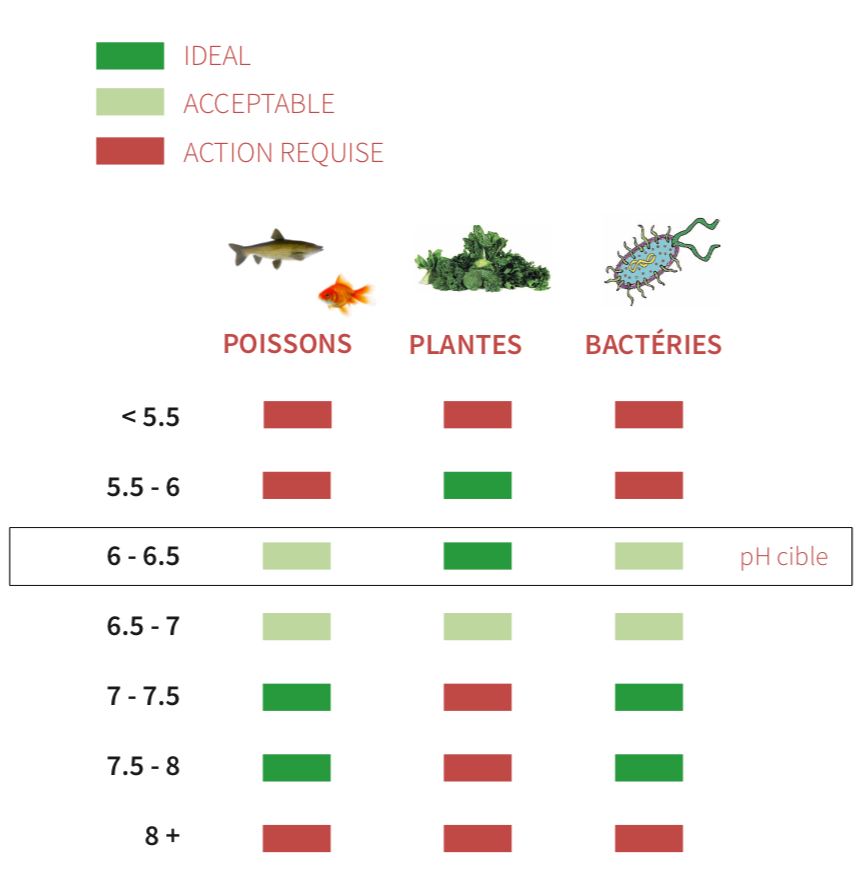
pH is a parameter to control in order to:
- Ensure the health and well-being of the fish
- Promote root absorption of minerals by the plants
- Maintain a bacterial population that enables the nitrogen cycle
The right compromise to satisfy these 3 populations is therefore a pH of 6,5.
2. How to manage pH
The pH probe must be immersed directly in the water of the fish tanksOn receipt, the pH probe is stored in a vial with a preservation solution.
Remove it before placing the probe directly in the water of the fish tanks.
Managing pH means knowing the hardness of the water. The harder the water, the more difficult it is to change the pH.
So-called “hard” water is rich in minerals and therefore has a buffering effect on pH, meaning it tends to keep it stable. This is why you need softer water with a hardness between 4 and 5°d on the strip test.
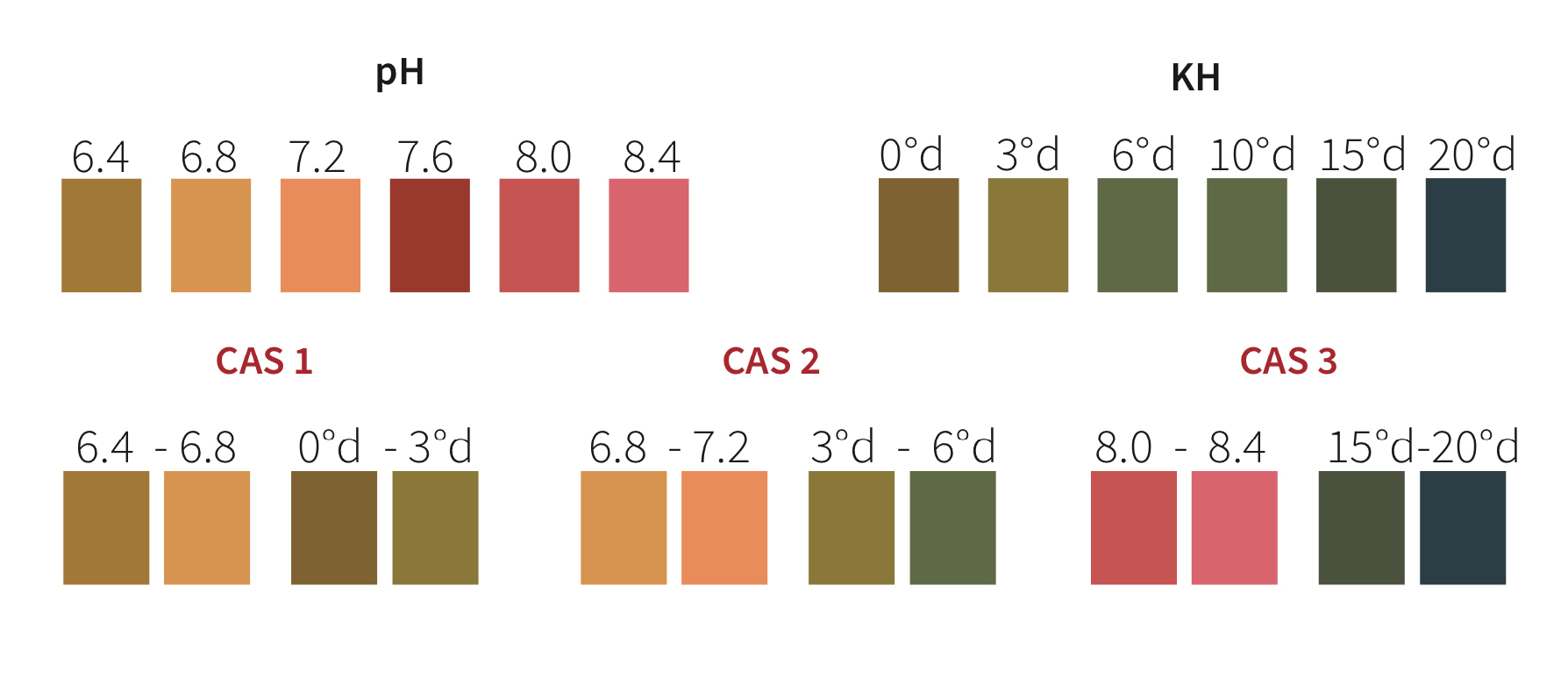
Your water parameters are generally those of case no. 3, high pH and hard water.
To quickly reduce the hardness of the water in the fish tanks, fill:
- 2/3 of the fish tanks with reverse osmosis water or rainwater (up to ¾ if the water is very hard)
- 1/3 with tap water
If your fish tanks are already filled with tap water, top up evaporated water with rainwater and/or reverse osmosis water.
To gradually lower the pH: add the following amounts of pH Down every 48h until the target is reached. pH Down helps neutralize carbonates and add acids to the environment, which is why the pH gradually decreases.
| Volume of pH Down (ml) | Family | City |
| Without fish | 100 | 30 |
| With fish | 50 | 10 |
To increase the pH and hardness of the water:
- Either add the following amounts of potassium bicarbonate:
| Number of teaspoons of potassium bicarbonate | Family | City |
| Without fish | 6 per tank | 3 per tank |
| With fish | 3 per tank | 1 per tank |
- Or top up the water level in the fish tanks with tap water
3. pH changes over time

Case 1
Excessive pH fluctuations mean there are few carbonates in your system, so there is no buffering effect. Check the carbonates with a test strip and correct by adding tap water or potassium bicarbonate.
Daily pH fluctuations – sinusoidal type – are caused by the presence of algae in the fish tank. To remove them, you can refer to this article .
Case 2
A pH that drops suddenly indicates a serious problem. It is possible that the filtration system or the pump has a problem, or that the fish are being overfed. Check that everything is properly connected and that the fish food reservoir has not fallen into the water.
pH tends to gradually decrease naturally over time, since plants release acids as they absorb minerals.
Case 3
A pH that is too acidic means that you probably no longer have enough carbonates in your system. Check the carbonates with a test strip and correct if necessary.
Case 4
A pH that is too high means that you have too many carbonates in your system. Check the carbonates with a test strip and correct if necessary.
Case 5
Excessive pH fluctuations mean there are few carbonates in your system, so there is no buffering effect. Check the carbonates with a test strip and correct if necessary.