
Fish nutrition
One of the most important elements in aquaponics.
The certified organic fish food offered by our agronomists is at the cutting edge of current knowledge and meets the nutritional needs required by a majority of species present in the aquaponics system at different stages of their life.
Nutritional needs are fully covered by an optimal and balanced supply of proteins, essential amino acids, lipids, vitamins and minerals.
You can order our organic food from our store
Please note that the quantity suggested in the instructions is indicative only. The actual quantity dispensed may be higher or lower. Parameters such as temperature, pH and fish age (one month vs 10 months) influence their appetite.
Adjust the quantity: increase it if the fish show a strong appetite or, conversely, reduce it if a lot of food remains suspended.
1. Feeding habits of the different fish families in aquaponics
For cold-water fish (salmonids, rainbow trout, brown trout, salmon trout): omnivorous - visual feeding at the surface.
For temperate-water fish (cyprinids, common carp, goldfish):
omnivorous, algae, snails (feeding from the bottom, mid-water and the surface).
For warm-water fish (cichlids, tilapia):
omnivorous with a tendency towards vegetarian feeding (feeding from the bottom and in open water).
2. Fish dietary needs
Proteins are the cornerstone of fish feed. The combination of plant proteins (wheat, peas, fava bean and soy) and high-quality animal proteins in the composition provides the right balance of essential amino acids, delivers the best palatability, and guarantees high digestibility and assimilation.
The high proportion of plant proteins helps reduce the environmental impact of the feed.
Lipids, derived from soybean oil and fish oil, are the main source of energy for fish and are part of the structure of cell membranes. The essential fatty acids ω6 and ω3 contained in lipids are not synthesised by fish and are therefore important for their nutrition and physiology. In quantitative terms, lipids account for 17% of the feed ration. This high content benefits fish such as trout. On the other hand, the concentration of different fatty acids, especially ω6 and ω3, is maintained to meet fish needs and thus avoid deficiencies.
Carbohydrates are not naturally part of the diet of fish such as trout. The proposed ration contains a low carbohydrate content (starch), to avoid the risks of too much glycogen in the liver (hypertrophy), slower growth and higher mortality. As a result, the quality of these table fish is improved, as they are not excessively fattened.
Vitamins are included in the feed ration given to fish because they are involved in many enzymatic reactions. A deficiency can have serious consequences for the formation and overall health of the fish. For example, a deficiency in ascorbic acid causes malformation of the fish skeleton.
Present in small amounts in the ration, minerals play an essential role in fish. Deficiencies in calcium, phosphorus or magnesium, etc., cause abnormalities in formation and proper metabolic function.
3. Influence of temperature on nutritional needs
Each fish species has its own optimal activity temperature. For rainbow trout, this temperature is 15°C. Below 9°C, rainbow trout grows very slowly. For common carp, the optimal activity temperature is 15 to 25°C. Beyond these extremes, carp feed very little. Tilapia prefers warm water between 15 and 38°C.
An increase in water temperature promotes fish activity and therefore feeding, because they expend more energy. For trout, for example, protein needs increase as temperature rises from 7 to 18°C. The increase in protein requirements with temperature is covered by an increase in the amount of food consumed.
In the same way, fat requirements increase with temperature, because fish are more active at 15°C (example of trout). In low-temperature conditions, the intestinal cavity is filled with fat as the fish consume lipids.
Tolerance to rations with high carbohydrate content is lower at low temperatures. The percentage of glycogen in the blood is higher and the liver is larger under these rearing conditions.
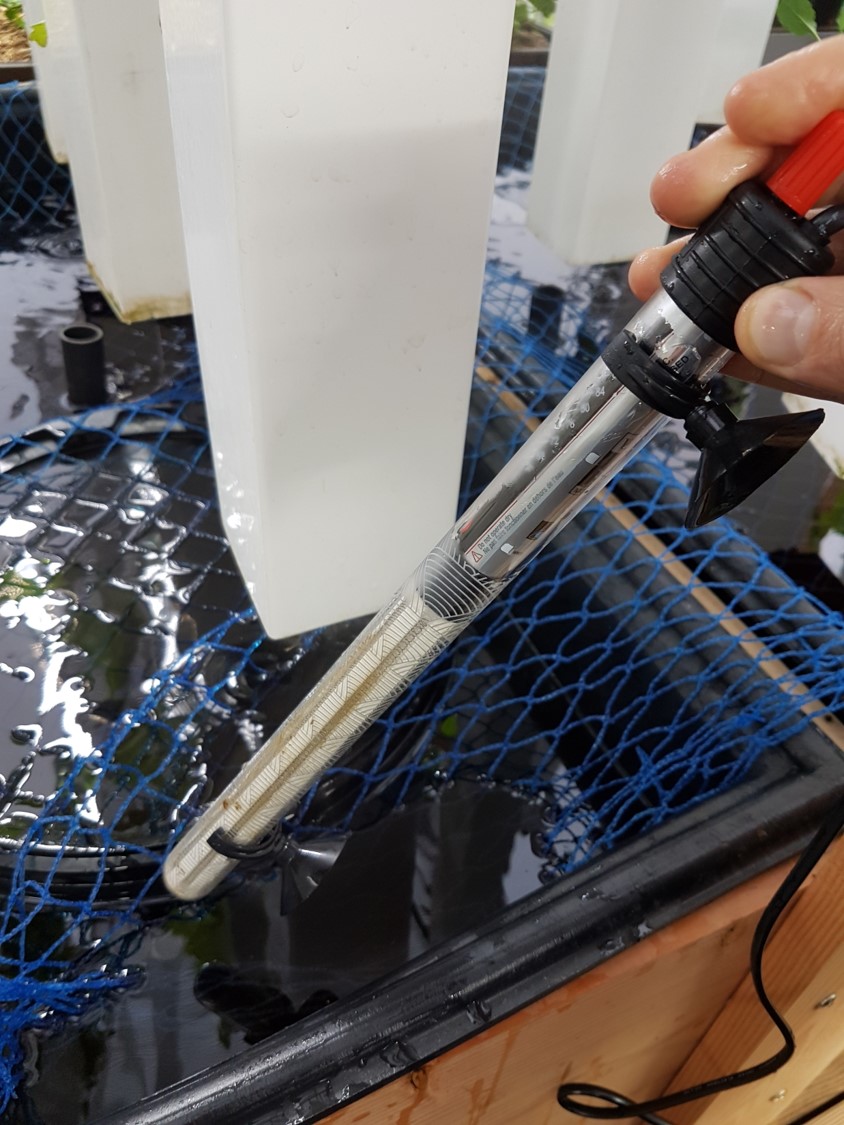
Low water temperatures in winter can limit the activity of cold-water fish such as trout. To stimulate their activity and therefore their food consumption, the temperature can be increased using a heater immersed in the fish tank.
4. Characteristics of the food pellets
The proposed feed is suitable for all diet stages (starter and production), because there is a mixture of protein sources and a complete supply of essential fatty acids and vitamins.
The pellets are made in a diameter that allows them to be ingested by the fish. The specific density of the pellets allows them to float in mid-water. The good cohesion of the fine particles of the different ingredients limits water fouling through disintegration.
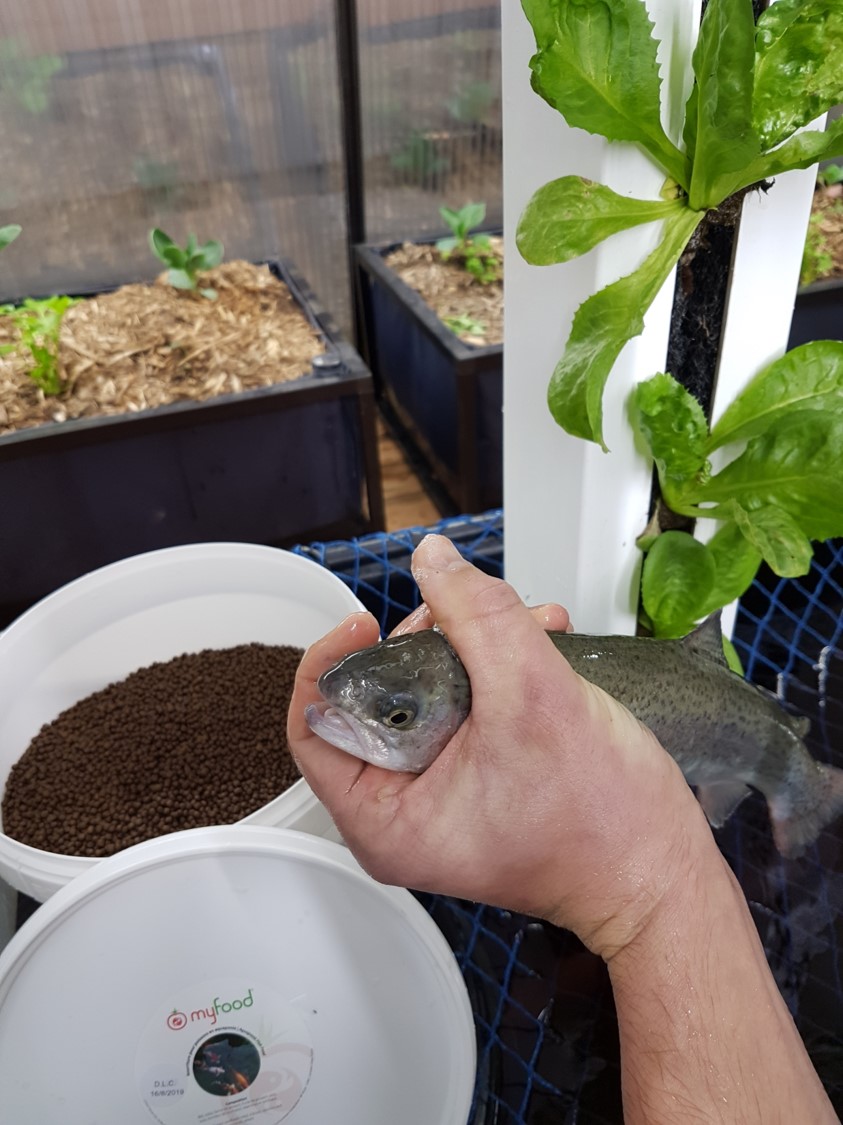
Semi-floating pellets are suited to the feeding behaviour of brown trout, which take food by sight in mid-water and at the surface.
5. Factors influencing the feeding rate
Several factors are involved in fish feed intake. It is possible to partially control some of these factors in the aquaponics system. Other factors linked to fish physiology need to be understood in order to understand fish feeding behaviour.
At a very young stage, fish are not inclined to consume dry food, especially at very low temperatures. This happens little by little.
The season influences fish activity. In summer, the light level and heat are high, and fish activity is therefore greater. In winter, the opposite is true.
Water quality (pH), as well as water pollution, especially from excess nitrates or the presence of algae, tank size, stocking density and the physiological state of the fish, all influence feed intake. So make sure to keep the water clean.
Excess foodBeware of excess food, which can promote bacterial growth and cause an increase in biological oxygen demand. This is harmful to fish!
6. Feeding rate
The feeding rate corresponds to the percentage of body weight fed per day. Feeding tables exist to meet fish food requirements according to their size and water temperature. Feed input into the fish tanks is planned by estimating the total weight of the fish biomass.
Indicative feeding rate for trout from 100 to 500 grams (and ornamental fish)At a temperature of 5°C, give the equivalent of 0,5% of the fish biomass weight (i.e. kg of feed / 100kg of biomass / day). Up to 15°C, gradually target 1,6%.
Indicative feeding rate for carp from 400 to 1200 gramsAt a temperature of 10-12°C, give the equivalent of 1% of the fish biomass weight (i.e. kg of feed / 100kg of biomass / day). Up to 24°C, gradually target 3,5%.
Indicative feeding rate for tilapiaOverall, target an average value of 3% (kg of feed / 100kg of biomass / day) to meet nutritional needs regardless of water temperature.
Feeding frequency is limited to one to three times per day for adult fish, which move around all corners of the fish tanks to find food. Small fish move less to find food. It is advisable to provide it close to where they are located.
To provide feed, use automatic dispensers (which provide a maximum of 80 grams per day) and manual distribution to top up if needed.
Practical aspectsTo get as close as possible to maximum growth potential, fish are fed until they stop taking food. At cold temperatures in particular, fish grow more slowly because they consume less.
Their growth will therefore take longer compared with fish kept at higher temperatures.
In the event of a sharp rise in water temperature over a few days during a dark period (no photosynthesis), increasing the amount of food in the water would cause a reduction in dissolved oxygen content, despite the fish's strong appetite. This is dangerous for fish survival.
Any change in the quantity or pellet size of the food given to fish must be made gradually over several days.
The presence of food pellets at the surface means there is too much food for the fish. To maintain a good appetite in fish, it is better to offer too little food than too much!
7. Summary
For young fish
When fish are young, after being introduced into the water, they may be stressed by transport and change. To help the fish get used to it, it is important to feed them gradually.
- How often should fish be fed?
It is recommended to feed them every 3 days and then every 2 days, once the fish become active when the food is given.
In other words, if they take time to react, they are not yet used to it enough, so stay on every 3 days.
Then every 2 days, up to every day.
* What quantity?
Give a small handful (cupped hand, half full). If all the food is eaten quickly (within a few minutes), increase the ration.
Otherwise keep this quantity to start with.
| Water temperatures | Number of meals | Number of daily meals | Quantity of food (recommended programming depending on the dispenser) |
|---|---|---|---|
| T<7°C - Fish of | Fish under one year old | 0 to 1 | F01 |
| Fish over one year old | 1 | F01 to F02 | |
| 7°C< T < 14°C | Fish under one year old | 1 | F01 |
| Fish over one year old | 1 to 2 | F01 to F02 | |
| 15°C < T < 24°C | Fish under one year old | 1 | F01 |
| Fish over one year old | 2 | F01 and F02 | |
| 25°C < T | Fish under one year old | 1 to 2 | F01 |
| Fish over one year old | 2 to 3 | F01 and F02 |
- What should be done during winter?
For goldfish or temperate-water fish that are resistant to the cold, that is, as soon as the temperature is below 7°C, keep only one meal or even stop feeding.
For cold-water fish, feed them in quantity, that is, give 2 to 3 meals per day.